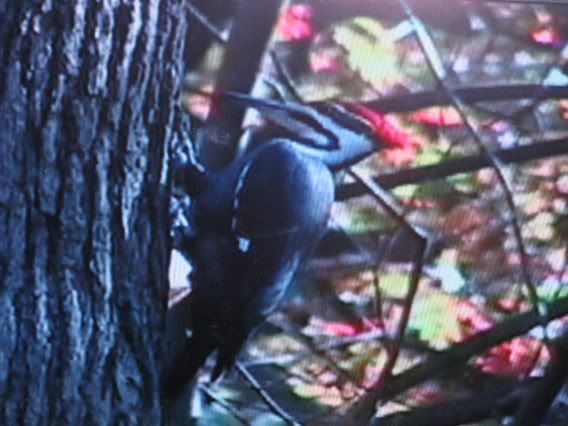
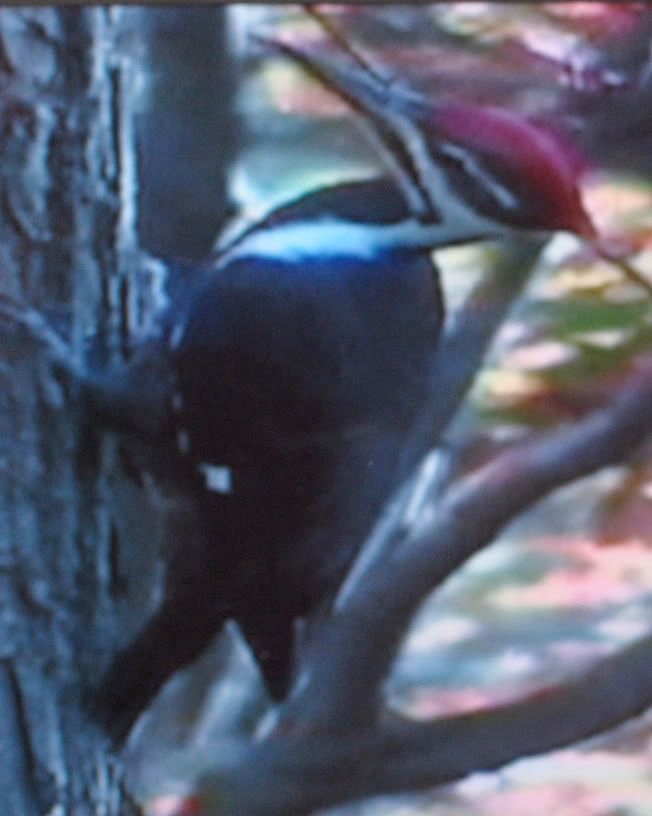
Nine paces from my office window, there is a large, dead tree with a roost hole sometimes used by Pileated Woodpeckers. Earlier this week, I saw a Pileated Woodpecker on that tree. At my leisure, I took out my Canon Mini-DV video camera and shot some handheld video through a none-too-clean window.
Not knowing an easy way to transfer this video to my Mac, I displayed it on my TV screen, took some digital photos with another camera, then uploaded these photos to photobucket.com. Here are two: Pileated 1; Pileated 2.
Obviously, these are not high quality pictures; however, they are orders of magnitude better than the Luneau video. These are the type of pictures that can be easily captured by any of the millions of "Joe Blows" armed with inexpensive digital cameras these days.
Some points about this bird:
--the bird did not disappear like a will-o'-the-wisp when I pulled out the camera. It hung around! Note that Tanner said the Ivory-bill in his experience was "certainly not noticeably more wary and wild than the Pileated Woodpecker. "
--it did indeed look huge. Expecting observers to use size to distinguish a lone "huge" bird from another that's an inch or two "huger" is asking too much. It's also too much to expect someone to distinguish a Greater Yellowlegs from a Lesser Yellowlegs based solely on size, given a lone bird without anything else available for size comparison.
--the bird did indeed move in a herky-jerky fashion, and its face could be described as "clown-like"
--the bill looked long, but it didn't look ivory in color.
--the bird eventually flew rapidly away, flying in a straight line with no apparent undulation
--as the bird flew away, I heard no loud wooden wing sound.
--those wings were flapping very quickly. I could see flashing black and white, but there is no way that I could reliably tell you exactly where the white was positioned, or whether the white was symmetrically placed on both wings.
--although the bird was little more than 30 feet away when it flew, and although it was sunny, I absolutely could not see "light shining off veins in the primary feathers".
Friday, October 21, 2005
Thursday, October 20, 2005
Article critical of "60 Minutes" Ivory-bill story
This Arkansas Leader article contains some criticism of Ed Bradley and the "60 Minutes" Ivory-bill story that aired earlier this week.
Perhaps the author harbors some skepticism about the Ivory-bill:
---
Scientists think as many as a dozen ivory-billed woodpeckers, if they exist at all, are hiding deep in the woods between those two spots...
---
Perhaps the author harbors some skepticism about the Ivory-bill:
---
Scientists think as many as a dozen ivory-billed woodpeckers, if they exist at all, are hiding deep in the woods between those two spots...
---


Pileateds photographed at bark scaling sites
Remote cameras have been set up at Cache River sites with "intriguing bark scaling". These cameras have captured photos of Pileated Woodpeckers, but never any photos of Ivory-billed Woodpeckers.
Here are some pictures.
Here are some pictures.
Wednesday, October 19, 2005
Let's see the Imperial Woodpecker video
An article in Nature contained this snippet:
---
And some authorities say that there is unpublished evidence that helps prove that the bird in the [Luneau] video is a pileated woodpecker. They are referring to a 1953 film of a flying imperial woodpecker (Campephilus imperialis), a species extinct in its home range of western Mexico. Some years ago, Lammertink secured a copy of the film, which had been taken by a birding enthusiast. It was among the evidence shown to ornithologist Michael Patten, research director at the University of Oklahoma's Sutton Avian Research Center in Bartlesville, when he visited Cornell in June.
Ornithologists generally agree that the imperial woodpecker is a sister bird to the ivory-billed, with many similar characteristics from coloration to the distinctive double-rap. But Patten was struck by the imperial's flight patterns. "As soon as I watched the film," he says, "I was absolutely certain they didn't have an ivory-billed woodpecker. The bird in the film flies utterly differently to the one in the Cornell video."
Fitzpatrick is not troubled by the film of the imperial woodpecker, arguing that it sheds little light on whether his video shows an ivory-billed. "They are like apples and oranges," he says of the two videos, because of different camera angles and stages of the birds' flights.
---
Since no video exists of a flying Ivory-bill, the Imperial Woodpecker video is a critical piece of evidence. In fairness, I think Cornell should make the Imperial video publicly available.
---
And some authorities say that there is unpublished evidence that helps prove that the bird in the [Luneau] video is a pileated woodpecker. They are referring to a 1953 film of a flying imperial woodpecker (Campephilus imperialis), a species extinct in its home range of western Mexico. Some years ago, Lammertink secured a copy of the film, which had been taken by a birding enthusiast. It was among the evidence shown to ornithologist Michael Patten, research director at the University of Oklahoma's Sutton Avian Research Center in Bartlesville, when he visited Cornell in June.
Ornithologists generally agree that the imperial woodpecker is a sister bird to the ivory-billed, with many similar characteristics from coloration to the distinctive double-rap. But Patten was struck by the imperial's flight patterns. "As soon as I watched the film," he says, "I was absolutely certain they didn't have an ivory-billed woodpecker. The bird in the film flies utterly differently to the one in the Cornell video."
Fitzpatrick is not troubled by the film of the imperial woodpecker, arguing that it sheds little light on whether his video shows an ivory-billed. "They are like apples and oranges," he says of the two videos, because of different camera angles and stages of the birds' flights.
---
Since no video exists of a flying Ivory-bill, the Imperial Woodpecker video is a critical piece of evidence. In fairness, I think Cornell should make the Imperial video publicly available.
Tuesday, October 18, 2005
Source: ARU cuts are likely Blue Jay calls
I have learned from an anonymous source that the Automatic Recording Unit (ARU) cuts trumpeted as being a good match for an Ivory-billed Woodpecker (and reported as such in a letter to Science in early September) are more likely of Blue Jays. Moreover, the sound collection at Cornell has several cuts of Blue Jays that seem to match, or at least account for, the sounds recorded on the ARUs.
Although in their own collection, it appears that these Blue Jay cuts were not examined before the Cornell team sent their latest offering to Science. Rumor has it that the Cornell team has since analyzed these Blue Jay cuts and acknowledged that they are a good match.
Although in their own collection, it appears that these Blue Jay cuts were not examined before the Cornell team sent their latest offering to Science. Rumor has it that the Cornell team has since analyzed these Blue Jay cuts and acknowledged that they are a good match.
Monday, October 17, 2005
"60 Minutes" Ivory-bill story
Here is a (partial?) transcript of last night's "60 Minutes" story on the Ivory-bill. As I expected, it was mostly a "feel-good" piece, and the skeptic's side was barely mentioned.
Here are just a few snippets, with my comments in red:
---
Sparling considered that it might be the smaller woodpecker that’s common around the region called “the pilleated,” but ruled it out. “I realized that if it was not a pilleated, the only other alternative was for it to be an ivory bill,” he says.
---
If you see a large woodpecker with more white on the wings than a normal Pileated, it's a mistake to say that ivory-bill is the only other alternative. The bird is vastly more likely to be an abnormal Pileated.
---
It’s one of the most exotic and the most inhospitable environments in America, a vast primordial ooze, a place so wild, that the Big Woods have been called this country’s Amazon.
---
I think they're seriously overselling this point. Some of the reported sightings took place not far from the road. The area is not wild enough to deter hundreds if not thousands of duck hunters.
---
Russ Charif, a researcher at the lab, played a tape recorded Jan. 29, 2005 in Arkansas, which he says “bears a striking resemblance” to two ivory-billed woodpeckers talking to each other.
Or two Blue Jays talking to each other. Later this week, I'll post some more detail on this issue.
That sound has been music to the ears in Clarendon, Ark., the town closest to the sighting, which isn't waiting for the outcome of the scientific debate to cash in on the woodpecker’s return.
This is one of the few sentences mentioning the controversy.
---
Here are just a few snippets, with my comments in red:
---
Sparling considered that it might be the smaller woodpecker that’s common around the region called “the pilleated,” but ruled it out. “I realized that if it was not a pilleated, the only other alternative was for it to be an ivory bill,” he says.
---
If you see a large woodpecker with more white on the wings than a normal Pileated, it's a mistake to say that ivory-bill is the only other alternative. The bird is vastly more likely to be an abnormal Pileated.
---
It’s one of the most exotic and the most inhospitable environments in America, a vast primordial ooze, a place so wild, that the Big Woods have been called this country’s Amazon.
---
I think they're seriously overselling this point. Some of the reported sightings took place not far from the road. The area is not wild enough to deter hundreds if not thousands of duck hunters.
---
Russ Charif, a researcher at the lab, played a tape recorded Jan. 29, 2005 in Arkansas, which he says “bears a striking resemblance” to two ivory-billed woodpeckers talking to each other.
Or two Blue Jays talking to each other. Later this week, I'll post some more detail on this issue.
That sound has been music to the ears in Clarendon, Ark., the town closest to the sighting, which isn't waiting for the outcome of the scientific debate to cash in on the woodpecker’s return.
This is one of the few sentences mentioning the controversy.
---
Bombshell from the USFWS?
To me, it seems pretty clear that the US Fish and Wildlife Service is backing away from the Ivory-bill story. One exhibit was this press release, which downplayed the Ivory-bill as a reason for an 1,800-acre land purchase in the Cache River area.
Now, their recently-released Recovery Plan Outline appears to contain a bombshell.
---
The Ivory-billed Woodpecker is assigned a recovery priority number of 18 on a scale of 1C (highest) to 18 (lowest; the “C” indicates the potential for conflict with human economic activities) (USFWS 1983a,b).
---
Now why is that a bombshell? I found some related information here:
---
Species with a high priority rank (1, 1C, 2, 2C) are those that are the most threatened and have the highest potential for recovery. Species with a low rank (16, 17, 18) are the least threatened and have low recovery potentials.
---
At the link above, there's a table that shows recovery priority numbers for many species as of September 2002. Note that Whooping Crane and Piping Plover are assigned 2C; Red-cockaded Woodpecker gets an 8C; Bald Eagle gets a 14C, and Ivory-billed Woodpecker rated a 17.
Ok, so the story is: "The Ivory-billed Woodpecker lives!! People around the world sob with joy over the news. This may be the biggest conservation story of the century."
If the USFWS believed the story above, I would think they'd assign the Ivory-bill a recovery priority number pretty near 1. Since they've actually assigned the Ivory-bill an 18, I think they're skeptical.
Now, their recently-released Recovery Plan Outline appears to contain a bombshell.
---
The Ivory-billed Woodpecker is assigned a recovery priority number of 18 on a scale of 1C (highest) to 18 (lowest; the “C” indicates the potential for conflict with human economic activities) (USFWS 1983a,b).
---
Now why is that a bombshell? I found some related information here:
---
Species with a high priority rank (1, 1C, 2, 2C) are those that are the most threatened and have the highest potential for recovery. Species with a low rank (16, 17, 18) are the least threatened and have low recovery potentials.
---
At the link above, there's a table that shows recovery priority numbers for many species as of September 2002. Note that Whooping Crane and Piping Plover are assigned 2C; Red-cockaded Woodpecker gets an 8C; Bald Eagle gets a 14C, and Ivory-billed Woodpecker rated a 17.
Ok, so the story is: "The Ivory-billed Woodpecker lives!! People around the world sob with joy over the news. This may be the biggest conservation story of the century."
If the USFWS believed the story above, I would think they'd assign the Ivory-bill a recovery priority number pretty near 1. Since they've actually assigned the Ivory-bill an 18, I think they're skeptical.
Sunday, October 16, 2005
Twenty full-time searchers, plus 100 volunteers
In this article, Ron Rohrbaugh of Cornell talks about the Ivory-bill searches in Arkansas.
---
The 39-year-old director of the Cornell Lab of Ornithology's Ivory-billed Woodpecker Research Project saw the fabled bird while leading a search crew in the Mississippi Delta bayou in April 2004.
"I saw the bird for no more than 2½ or 3 seconds," Rohrbaugh relays.
His sighting was not one of the seven documented in the Science journal announcing the finding earlier this year. "I was not able to get field marks. That happened to several other people as well."
But, he says, "I checked it off my list. As a birder, there are several levels of identification, and your gut tells you. I know what I saw."
---
(Note: As always, unless otherwise noted, I've added the bold font for emphasis.)
Here is one snippet:
---
Another field season will begin in Arkansas on Nov. 1 and run through April 30. Rohrbaugh will direct 20 full-time paid staff and 100 volunteers to comb what he calls a "massive tract of land."
Experts have announced that at least one male ivory-bill has been seen and heard in the Big Woods. But, Rohrbaugh says, "We have audio recordings of what we believe to be two birds communicating."
---
---
The 39-year-old director of the Cornell Lab of Ornithology's Ivory-billed Woodpecker Research Project saw the fabled bird while leading a search crew in the Mississippi Delta bayou in April 2004.
"I saw the bird for no more than 2½ or 3 seconds," Rohrbaugh relays.
His sighting was not one of the seven documented in the Science journal announcing the finding earlier this year. "I was not able to get field marks. That happened to several other people as well."
But, he says, "I checked it off my list. As a birder, there are several levels of identification, and your gut tells you. I know what I saw."
---
(Note: As always, unless otherwise noted, I've added the bold font for emphasis.)
Subscribe to:
Posts (Atom)


 Posts
Posts