Showing posts with label hurricanes. Show all posts
Showing posts with label hurricanes. Show all posts
Wednesday, September 17, 2008


Wednesday, March 26, 2008
Global warming: Just deal with it, some scientists say
See the whole Los Angeles Times story here.
Excerpt:
Excerpt:
Exhibit A is hurricanes.Commenting on this story, Marc Morano wrote:
The spate of recent storms, particularly Hurricane Katrina in 2005, has come to be seen as a harbinger of a warmer world -- a view popularized by Gore's 2006 documentary, "An Inconvenient Truth."
Pielke's new analysis considered 207 hurricanes that hit the United States between 1900 and 2005. He looked at their strength and course and then overlaid them on a modern map that included all development over the years.
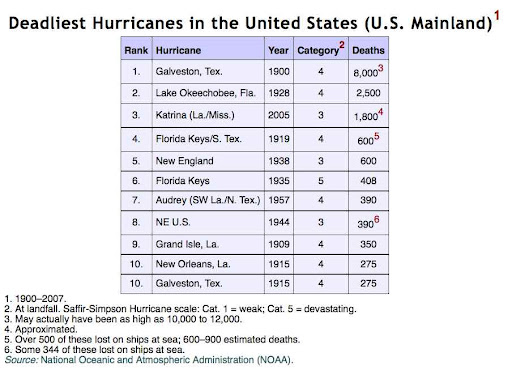
He found that the most devastating storm, had it occurred today, would be the Great Miami Hurricane of 1926, popularly known as the Big Blow. Its path through the now heavily developed southern tip of Florida would have caused $157 billion in damage, followed by Katrina, whose toll was $81 billion. Six of the top 10 most damaging storms occurred before 1945.
...
Pielke says that even if his critics are right, it is becoming clear that the world lacks the political will to enact global emissions cuts.
China's growing emissions are on pace to double those of the United States in a decade, and the country shows little interest in slowing down. The United States has refused to cap its emissions, and much of Europe is failing to satisfy even the modest terms of the Kyoto Protocol, the 1997 landmark treaty on greenhouse gases.
"I would characterize us as realists," Pielke said. "Realists on what is politically possible."
Note: this is significant. The mainstream media (LA Times) now realizes there is no 'consensus' and that so called 'solutions' to global warming are purely symbolic and unworkable. So they are now featuring the 'non-skeptic heretic club.' The media is beginning to understand and promote the Lomborg warming is happening, but not a crisis position.
Tuesday, January 22, 2008
Tuesday, January 15, 2008
Try to pick out the storms that were caused by SUVs

Friday, November 30, 2007
Instapundit on weather inflation
Here.
Excerpt:
Excerpt:
A lot of people seem to be interpreting this as global-warming hype, but it's probably just bureaucratic mission creep. If you're the National Hurricane Center, you need hurricanes to stay in business. If hurricanes fall off, you're tempted to cook the books just a bit. Ditto for the rest of the weather establishment. Blizzards are okay, tornadoes good for a bit of quick fun, but hurricanes are the real money-maker, combining intense fearfulness with multiday longevity like nothing else.
Monday, October 08, 2007
If a large hurricane struck NYC, should we immediately blame CO2?
From World Climate Report here:
The pair of geologists was able to reconstruct storm surge levels in the New York City area, and as seen in Figure 1, largest surges are found in 1788, 1821, and 1893. Maybe it is just us at World Climate Report, but we fail to see any trend upward coincident with the buildup of greenhouse gases. Furthermore, we notice that the three large surges occurred during a time when, last we checked, the Northern Hemisphere was considerably cooler than what we have today.

Figure 1. Storm surge heights relative to modern mean sea level which accompanied the 1788, 1821, and 1893 hurricanes inferred from historic archives and the most extreme flooding events of the 20th century recorded by the Battery Park (New York City) tide gauge from 1920 to present (from Scileppi and Donnelly, 2007)
Friday, September 21, 2007
Seriously misinforming the public
Last May, this appeared in the New York Times:

But check this out:
An excerpt from his 'Open Letter' (found at the link above):
When people worry about the effects of global warming, they worry more about hurricanes than anything else . In surveys, almost three-quarters of Americans say there will be more and stronger hurricanes in a warming world. By contrast, fewer than one-quarter worry about increased coastal flooding.People who watched "An Inconvenient Truth" are led to believe that a scientific "consensus" supports that fear.

But check this out:
A leading expert in the field of tropical storms and hurricanes has withdrawn from participation in the writing of the IPCC’s Fourth Assessment Report (due out in late 2007), citing concerns that the IPCC has become too politicized, and “motivated by pre-conceived agendas.”
Dr. Christopher Landsea, from the Hurricane Research Division of the National Oceanographic and Atmospheric Administration’s (NOAA) Atlantic Oceanographic and Meteorological Laboratory, has withdrawn from authorship of the Fourth Assessment Report of the United Nations’ Intergovernmental Panel on Climate Change (IPCC), a compendium due to be published in 2007. Landsea, author of over 40 refereed scientific publications over the past 12 years on hurricanes and other tropical storm systems has been a contributing author in the last two IPCC Assessments, primarily responsible for the sections describing the past, present, and future behavior of tropical cyclones.
In a ‘Open Letter’ to his colleagues, Landsea announced and justified his decision.
An excerpt from his 'Open Letter' (found at the link above):
...All previous and current research in the area of hurricane variability has shown no reliable, long-term trend up in the frequency or intensity of tropical cyclones, either in the Atlantic or any other basin. The IPCC assessments in 1995 and 2001 also concluded that there was no global warming signal found in the hurricane record.
Moreover, the evidence is quite strong and supported by the most recent credible studies that any impact in the future from global warming upon hurricane will likely be quite small. The latest results from the Geophysical Fluid Dynamics Laboratory (Knutson and Tuleya, Journal of Climate, 2004) suggest that by around 2080, hurricanes may have winds and rainfall about 5% more intense than today. It has been proposed that even this tiny change may be an exaggeration as to what may happen by the end of the 21st Century (Michaels, Knappenberger, and Landsea, Journal of Climate, 2005, submitted).
Subscribe to:
Posts (Atom)


 Posts
Posts

