Please mention that my Pileated page has been updated with a link to a new page containing clear jpegs for all of my Pileated Woodpecker frames. And the MOV clip will probably play clearer for many viewers. I had forgotten that older versions of QuickTime (before 7) automatically played DV-formatted clips at the low-resolution setting.
Saturday, January 14, 2006
Updated Pileated page
Malcolm Mark Swan writes:


Friday, January 13, 2006
Funding for the IBWO Recovery Effort
Here is a US Fish and Wildlife Service document (PDF format) with some details on the funding for the Ivory-bill Recovery Effort.
Partial Cues
On page 38 of his excellent book "Sibley's Birding Basics", David Sibley writes (the bold font is mine):
I think this example provides one illustration of the power of the human mind to use partial cues:
...Even a glance of a partially obscured sign or very distant sign can allow you to recognize familiar product logos. Your brain has a tremendous power to filter out distractions and fill in details of familiar patterns, and patterns in birds are no exception.In the case of "Ivory-bill" sightings, I think an observer might conceivably get a fleeting glimpse of a bird that apparently shows "too much white" on only one upperwing, and then "fill in the details" so that extra white on both upperwings might be later remembered. The partial cue of apparent extra white on the upperwing could also influence the observer to unconsciously fill in other "extra" details beyond what was actually seen--maybe impression of overall size, flight style, bill length, etc.
That said, there is a danger in filling in details in this way. You can jump to conclusions and convince yourself that certain desired details were actually seen...
I think this example provides one illustration of the power of the human mind to use partial cues:
Here, take heart. I love re-reading this as I too am a bad speller.
Believe it or not, you can read it.
I cdnuolt blveiee taht I cluod aulaclty uesdnatnrd waht I was rdgnieg.
The phaonmneal pweor of the hmuan mnid. Aoccdrnig to rscheearch, it deosn't mttaer in waht oredr the ltteers in a wrod are, the olny iprmoatnt tihng is taht the frist and lsat ltteer be in the rghit pclae. The rset can be a taotl mses and you can sitll raed it wouthit a porbelm.
Tihs is bcuseae the huamn mnid deos not raed ervey lteter by istlef, but the wrod as a wlohe.
Amzanig huh?
Thursday, January 12, 2006
"Too many" credible sightings?
The "too many credible sightings" point is made once again here:
When I mention Bigfoot, a typical response is "well, Bigfoot never existed, and we know the Ivory-bill did exist".
First of all, I'm not sure why that distinction matters much, since we are still comparing two high-profile U.S. "species" that may not exist today. Second of all, it's been argued by some (not me) that Bigfoot could a living descendant of something called Gigantopithecus.
I don't think we have a serious shortage of Bigfoot believers. If you're interested, please check out the websites for recent Bigfoot conferences in Texas and Pennsylvania. (Note that the Texas conference website says they had "official attendance of over 500 for both days").
FIRST there is simply the long history of repeated sightings of this bird over five decades, time and time and time again in various locales, no not confirmed, but repeated sightings by credible observers, probabilistically, MEAN SOMETHING!!...When NO credible sightings/claims have occurred for 75 successive years THEN come talk to me about the likelihood of extinction...Here are some similar arguments:
There were 40-some sightings last year," said Rickie Roberts..."There were 22 sightings in one day. ... There's even one guy who swears there's a family ... who live behind his house."...Roberts' wife, Beverly, said too many credible people have seen [it] for her not to believe it exists. "I've got family members who firmly believe they've seen it," she said..."Whatever it is, there is something." Tracy Nichols and Sue Page, who work at City Hall, said they have heard scores of ... [related] tales over the years.The arguments in the paragraph above were actually used to support the theory that a "legendary Bigfoot look-alike" called the "Fouke monster" exists in Arkansas. No one seems able to get a clear photograph of the Fouke monster.
When I mention Bigfoot, a typical response is "well, Bigfoot never existed, and we know the Ivory-bill did exist".
First of all, I'm not sure why that distinction matters much, since we are still comparing two high-profile U.S. "species" that may not exist today. Second of all, it's been argued by some (not me) that Bigfoot could a living descendant of something called Gigantopithecus.
I don't think we have a serious shortage of Bigfoot believers. If you're interested, please check out the websites for recent Bigfoot conferences in Texas and Pennsylvania. (Note that the Texas conference website says they had "official attendance of over 500 for both days").
Wednesday, January 11, 2006
Again with the wariness
More from Julie Zickefoose (the bold font is mine):
[Nancy Tanner] brought a DVD which had clips of ivory-bills at the nest--a male and female. It was stunning to see the photo stills we all know so well, moving and even calling--the male's bill opening, that strange tooting call being given. They are shiny, shiny birds, so strong and vigorous. They looked nervous, and Nancy said they were--nervous about the grinding camera and the crew below their nest. Imagine!
A rare bird, digitally documented
Don Hendershot writes about documenting a rare Yellow-headed Blackbird for a recent Christmas Bird Count:
Photo credit: Wayne Forsythe
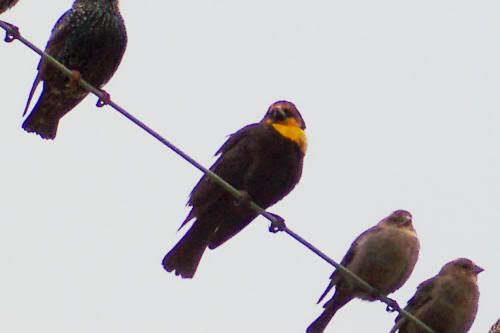
Thanks to modern technology the bird was digitally documented. Westphal called count compiler Bob Olthoff by cell phone. Bob and Wayne Forsythe joined her group at the test farm and the bird was relocated. Thankfully it was not camera shy and undoubtedly does not have that “blurry” gene that has foiled attempts at documenting the ivory-billed woodpecker. Forsythe was able to get photos with one of those shirt-pocket digital cameras. Bob and Wayne identified the bird as a first-year male.
Photo credit: Wayne Forsythe
The scienceNOW Ivory-bill segment
The segment was roughly seven minutes long and should be available online today here.
A few notes:
1. Jerome Jackson said the Luneau bird is "clearly not an Ivory-bill".
2. Jackson held up one of these "found!" caps and suggested that the exclamation point should be changed to a question mark.
3. I think Jackson did a good job of explaining why, as a Pileated powers straight away from you, you see its flashing white underwings. In my opinion, Fitzpatrick looked rather grim in weakly arguing (without further explanation) that we are actually seeing the upperwings in that situation.
4. The narrator then said "Fitzpatrick backs up his argument with audio evidence", failing to mention that this particular audio evidence was collected a long distance from the site of the Luneau video (maybe 50 miles or more).
5. Russ Charif played an ARU recording of a "mystery bird", noting (as I did here) that the fourth note is different. (He calls it "lower"; I called it "sour").
He then played four known Blue Jay notes, and pointed out that unlike "the mystery bird", these particular four Blue Jay notes were on the same frequency. I think that is a meaningless comparison.
A few notes:
1. Jerome Jackson said the Luneau bird is "clearly not an Ivory-bill".
2. Jackson held up one of these "found!" caps and suggested that the exclamation point should be changed to a question mark.
3. I think Jackson did a good job of explaining why, as a Pileated powers straight away from you, you see its flashing white underwings. In my opinion, Fitzpatrick looked rather grim in weakly arguing (without further explanation) that we are actually seeing the upperwings in that situation.
4. The narrator then said "Fitzpatrick backs up his argument with audio evidence", failing to mention that this particular audio evidence was collected a long distance from the site of the Luneau video (maybe 50 miles or more).
5. Russ Charif played an ARU recording of a "mystery bird", noting (as I did here) that the fourth note is different. (He calls it "lower"; I called it "sour").
He then played four known Blue Jay notes, and pointed out that unlike "the mystery bird", these particular four Blue Jay notes were on the same frequency. I think that is a meaningless comparison.
Tuesday, January 10, 2006
More on the Habitat Quest
Here's a paragraph from Laura Erickson:
(If you think my gentle needling is a bit "mean", please rest assured that Laura has directed her share of barbs at me in the past. It's all in good fun, right?)
All day I was aware that this was a forest where an Ivory-billed Woodpecker may have spent some time. It's sad to me how much development and agriculture there is along the White River--there is a lot of "contiguous habitat," but wilderness this is not, by any stretch of the imagination. I can hear cars and airplanes from our campsite, to say nothing of gunfire, and there is a disturbing amount of trash--from beer and pop cans to toilet paper--in the woods. If the Ivory-billed Woodpecker depended on genuinely untrammeled wild habitat, we didn't leave it much at all. For that matter, we didn't leave much for those of US who depend on genuinely untrammeled wild habitat. This is a splendid place--but the Ivory-bill, and all these innocent little birds who don't even know about bird feeders, deserve ever so much better.In my humble opinion, Laura seems to be working a bit too hard to convince herself that Arkansas Pileateds are extremely hard to photograph. Note that in the past, she's taken some pretty good Pileated photos in Minnesota.
(If you think my gentle needling is a bit "mean", please rest assured that Laura has directed her share of barbs at me in the past. It's all in good fun, right?)
A "very, very conspicuous bird"
A reader pointed out these words from Nancy Tanner in a 1999 article by Julie Zickefoose (the bold font is mine):
We went back down at Christmas time of 1941 because he wanted to see what was happening there. There were still five ivorybills, and we spent two weeks down there. The bark [from their workings] peels off and falls on the ground, and that's how you find where they are. You could hear them [calling] a mile away, it seemed. They were extremely loud. Very loud. The pounding was pretty darn loud, too. They are a very, very conspicuous bird. They impressed me as being extremely large and gorgeous--so much white is showing. We had located one roost hole, so we were relatively close, sitting quietly on a log in the dark, soaking wet in the swamp. The bird is the last of the woodpeckers to come out [in the morning]. He climbed to the top, pounded, and then called; pounded and then called, and the female flew over next to him, and with a great racket they flew off.The reader added this comment:
Notice how, time after time, people marched in and got great looks at Ivory-bills. No big teams, no remote cameras, no GPS, undoubtedly no camo and ghillie suits. There was no need to debate whether they'd seen the bird, no need to interpret evidence, it was obvious they'd seen the birds.
Ivory-bill segment on KFAN
I listened with interest to the Birdchick and Stan Tekiela on Rob Drieslein's show last Saturday morning.
In his role as "devil's advocate", Rob asked some good, skeptical questions--more than I've heard on any other television or radio interview on the subject.
In Stan's view, Pileated Woodpeckers are "very very difficult" to photograph.
In response to a question from Rob, the Birdchick said "I've seen footage of this abnormal Pileated. It's got like two or three feathers on the back that are white that shouldn't be white." (Note that several abnormal Pileateds were seen in the search area).
When asked about the secrecy surrounding this year's search, the Birdchick mentioned that some of the land is "still public", and suggested that the secrecy was necessary to prevent some disgruntled person from "taking care of the bird".
To me, that explanation just doesn't make sense. As I've written previously, Cornell has already published a detailed map (North American Birds, Dec '04-Feb '05, page 199) showing exactly where each claimed sighting occurred.
According to the Cornell's secrecy rules, the Birdchick said she specifically is not allowed to say whether she "did or did not see" an Ivory-bill.
Hypothetically, let's say the Birdchick was allowed to publicly say "No, I didn't see an Ivorybill". I'm having a hard time understanding how that disclosure would put any living Ivory-bill in danger.
In his role as "devil's advocate", Rob asked some good, skeptical questions--more than I've heard on any other television or radio interview on the subject.
In Stan's view, Pileated Woodpeckers are "very very difficult" to photograph.
In response to a question from Rob, the Birdchick said "I've seen footage of this abnormal Pileated. It's got like two or three feathers on the back that are white that shouldn't be white." (Note that several abnormal Pileateds were seen in the search area).
When asked about the secrecy surrounding this year's search, the Birdchick mentioned that some of the land is "still public", and suggested that the secrecy was necessary to prevent some disgruntled person from "taking care of the bird".
To me, that explanation just doesn't make sense. As I've written previously, Cornell has already published a detailed map (North American Birds, Dec '04-Feb '05, page 199) showing exactly where each claimed sighting occurred.
According to the Cornell's secrecy rules, the Birdchick said she specifically is not allowed to say whether she "did or did not see" an Ivory-bill.
Hypothetically, let's say the Birdchick was allowed to publicly say "No, I didn't see an Ivorybill". I'm having a hard time understanding how that disclosure would put any living Ivory-bill in danger.
Monday, January 09, 2006
Upcoming lecture by John Fitzpatrick
I think this lecture's title is a bit interesting:
The keynote speaker will be John W. Fitzpatrick, director of the Cornell Lab of Ornithology. His provocative lecture title is “How ivory-billed woodpeckers (and other birds) will save the world.” He will speak on April 22, at 8 p.m.
More ID mistakes from experienced birders
In a post months ago, I mentioned David Sibley's writing on "group hysteria" in a birding context:
This problem can result in a sort of "group hysteria" when large numbers of birders look at the same bird. The suggestion by one person that the bird is a certain species forms an expectation for everyone else, who then looks only for field marks to confirm the "expected" identification. In one very well documented case in California, the first state record of the Sky Lark (a Eurasian species) was misidentified for days, and by hundreds of people, as the state's first Smith's Longspur.A reader from the UK pointed out two more examples:
One of the best known examples in the UK occurred at Landguard Point, Suffolk in June 1988. A Paddyfield Warbler (another 'mega' here, but is more frequent now) was trapped and ringed and, as it turned out, not seen after release. However, it was 'relocated' and over 1000 birders 'ticked' it over several days until it was pointed out that it was a scruffy Chiffchaff (a common warbler here). Paddyfield Warbler isn't the most distinctive of birds, but it is in a different genus to Chiffchaff. A good example of what you refer to as 'group think'.
One recent example over here (this week) involving experienced birders being confused by calls was of a Little Owl making an unusual call. They thought the bird could be a Scops Owl (another UK mega). This is covered in this Birdforum thread. (The finders have, to their credit, admitted their mistake).
Sunday, January 08, 2006
Nancy Tanner looks back
Bill of the Birds blogs about a visit from Nancy Tanner here:
Is it reasonable to believe that shortly afterwards, the remaining birds inexplicably managed an unprecedented quantum leap in wariness?
Nancy recalls her last visit [to the Singer Tract], in 1941, when they counted 9 ivorybills, though she saw only five. Just a few years later The Singer Tract was logged and the birds disappeared.Very late in the game, when there were maybe two dozen birds left, they were still not very difficult to see. Their nests were largely failing, their habitat was about to be destroyed, and evidently they were still no more wary than a Pileated Woodpecker.
Is it reasonable to believe that shortly afterwards, the remaining birds inexplicably managed an unprecedented quantum leap in wariness?
According to Nancy Tanner, Richard Pough, one of the last visitors to The Singer Tract to see the birds, was there as it was being logged. His encounter with a lone female ivorybill who kept calling and calling, but got no answer, moved him to pledge to save the wilderness. He later helped in the founding of The Nature Conservancy.So even the very last known bird was a vocal one. Is it reasonable to believe that at that time, there existed another completely undocumented population of nonvocal birds?
Another heard-only "Ivory-bill"
David Chaffin has submitted a couple of odd posts to the Tennessee birding listserv.
First this one:
First this one:
You could have blown me over with a single breath, but at about 4:30pm Central yesterday during the first day of a 4 day trip, Bob O'Dear and I heard the bird three times. Twice, it as the single high pitched shrill note, while the third time, it was the rapid fire cadence call. We are staying at Mallard Pointe Lodge and Reserve, the only private land adjacent to the restricted area. We have not heard the double pecking notes yet nor seen the bird, which I still think is a long shot, but I now feel better about our chances.Then this one:
A very memorable #799 ABA.
Will send more details as time allows.
The lodge here has a CD of about 4 vocalizations of the bird that we review daily. It was apparently obtained by a Cornell person who was not authorized to be in the restricted area, who is now being sought by Federal officials. Before he left the premises, he left the recordings here at the lodge.I've received a lot of emails about these odd posts. One emailer's tongue-in-cheek comment was: "The part I like best is clandestine Cornell employees one step ahead of the FBI!"
Subscribe to:
Posts (Atom)


 Posts
Posts

