Saturday, January 28, 2006

Luneau video camera angle

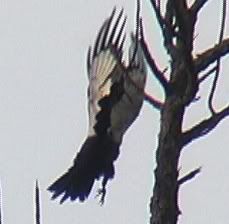
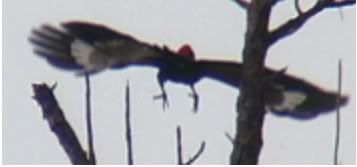
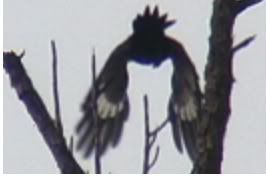
A couple of times recently, people have commented that the angle of the Luneau video differs from the angle of this Malcolm Swan Pileated video, so the videos are not comparable. I completely agree that the angles (and focus!) are not identical, but I would argue that the the videos can be usefully compared.

Specifically, the Swan Pileated video proves that a fleeing, normal Pileated shows a lot of flashing white underwing, both when the wings are above horizontal and when the wings are below horizontal.

Some people have tried to dismiss the Swan Pileated video because "the camera is directly under the bird", but note that the camera angle is not constant throughout the entire video. In the frames below, the camera orientation is nearly directly behind the bird (note that you can see the head sticking up on the second picture).

Note also that you'd see a lot of white underwing in any of these pictures, even if you changed the orientation of the bird a number of degrees in any (X/Y/Z) plane.

Friday, January 27, 2006

In-depth radio interview with Jerome Jackson

Jerome Jackson did a radio show that aired yesterday on the Ivory-bill saga. You can hear it at the WGCU web site.

It was on a program called "Gulf Coast Live" and a segment simply labelled "Birds!". Jackson's segment is about 18 minutes in length.

Thursday, January 26, 2006

"Jackson's Monkeywrench"

Here are some thoughts posted on the Internet since Jackson's Auk paper was published...

From a nature artist's blog posting, entitled "Jackson's Monkeywrench":
Reading his paper has caused me to reassess my own view of the evidence. I bought the hype, as I think most of us have. The Cornell Laboratory of Ornithology called the video conclusive, and that was good enough for me. I never even watched the clip to be honest, but now I feel I must. Whether that was an Ivorybill or a Pileated caught by Luneau's lens, Jackson's paper serves to remind us of a number of important lessons, about the scientific method, about the commodification of conservation, and most of all, about the way we learn about the world.

Any con man knows how easy it is to trick a person into believing what they want to believe most...
Updated WorldTwitch Ivory-bill page:
The longer the search goes on without confirmation, the more skeptical I become...Now, however, Jerome Jackson has pointed out in his article in the January 2006 Auk that the devices were placed near roads and campgrounds and not necessarily in the "deep woods". It's conceivable that the recordings are of Campephilus double raps broadcast from a tape recorder either by someone trying to locate birds or someone trying to fool the searchers...While I continue to hope that Ivory-billed Woodpeckers will be located, there still is no solid evidence that the Ivorybill did not become extinct about 50 to 60 years ago...The inability of a large team of searchers to find one in a patch of marginal habitat strongly suggests that this is simply another case of misidentification of the common Pileated Woodpecker, or as twitchers would say, stringing.
Minneapolis Star Tribune editorial (subscription may be required):
Was news of ivory bill's survival greatly exaggerated?

...Last spring, news of credible sightings prompted the sort of publicity that might attend the reemergence of a mastodon. Far less attention was paid the skeptics who thought announcing this resurrection on the strength of a mere seven sightings, some under challenge and none supported by hard evidence, was a bit of a stretch. Or, in the words of ivory-bill expert Jerome Jackson, an exercise in "faith-based ornithology."...But as time goes by, this woodpecker reminds us more and more of how often that other Elvis was said to have turned up alive.

Skeptical Ivory-bill papers from Brazil

Below are links to two papers published last year in Atualidades Ornitologicas in Brazil. I want to thank the lead author, Andre Nemesio, for allowing me to post these:

1. Paper 1 (PDF format), published in the May/June '05 issue, authored by Brazilian ornithologists A. Nemesio and M. Rodrigues.

2. Paper 2 (PDF format), published in the Nov/Dec '05 issue, authored by A. Nemesio, Jerome Jackson, and M. Rodrigues.

The branch stub

An anonymous person emailed me this:
To me, the following is the most significant quote in Dr. Jackson’s Auk article:

Figure S5A is likely a branch stub (J. Fitzpatrick pers. comm., 29 July 2005)

That means Fitzpatrick, leader of the Cornell team, has acknowledged that a claimed “Ivory-Bill” image from the famous Luneau video, the centerpiece of their evidence, is apparently a branch stub!

The text of Cornell’s Supporting Materials explains that an “indistinct object” was noticed on a tree in the video. When they put am IBWO model in the same spot, and filmed it out-of-focus in similar way to the poor quality original video, it looked much the same as “the object” in the video. Cornell concluded “We interpret the object in the Luneau video as an Ivory-Bill Woodpecker.”

Last September 6th, your blog examined the Luneau video and that object, and noted that there are numerous objects in the DVD that look indistinguishable from the “Ivory-Bill,” and that it was probable that they were all just vegetation and/or artifacts. You looked for a reasonable alternate explanation for Cornell’s “extraordinary claim” and your simple explanation was correct.

The revelation that Cornell is now saying that one of their “Ivory-Bills” was likely a branch stub is extremely important because it shows:

1. Cornell made at least one major blunder in their study, but have yet to admit it publicly.

2. Reenactments with models prove nothing if the test is flawed and results aren’t objectively evaluated. (Cornell's “flying Ivory-Bill” model with inflexible wings is another example of flawed models and tests.)

3. Blurry video and photos are easily misinterpreted.

4. Groupthink was definitely a factor in the study. Only groupthink would allow a team of intelligent people, including professional ornithologists, to identify a tree branch as “one of the rarest birds alive.”

5. The evidence as a whole is terribly weak if Cornell attempted to “spin” such a poor image into an Ivory-Bill.

6 If Cornell mistook a tree branch for an IBWO, surely it would be easier to mistake a Pileated for an IBWO, and easier yet to mistake a glimpse of an aberrant Pileated for an IBWO.

7. It illustrates that “the desires and expectations people possess influence their perceptions and interpretations of what they observe.”

In short, Cornell saw what they wanted to see, something that wasn't there, in that blurry image. I’m afraid that history will conclude that that was the case with all their Ivory-Bill sightings.

Wednesday, January 25, 2006

South Carolina Ivory-bill search

Someone just emailed me this link (the bold font is mine):
The U.S. Fish and Wildlife Service, in cooperation with their partners in the South Carolina Ivory-billed Woodpecker Working Group, are seeking volunteers for conducting ground searches for the Ivory-billed Woodpecker (IBWO) in South Carolina for the 2006 Field Season. Work will begin on/around 20 February 2006 and may continue through 30 April 2006.
...
The South Carolina Ivory-billed Woodpecker Working Group is a joint partnership between Federal and State agencies, non-governmental organizations, and private entities, sharing information and resources related to Ivory-billed Woodpecker issues in South Carolina. This group will be funded by the U.S. Fish and Wildlife Service to conduct searches for IBWO in South Carolina during the 2006 Field Season.

Laura Erickson weighs in

I believe Laura Erickson is wrapping up her Arkansas "Ivory-bill Habitat Quest" today.

Yesterday, she wrote:
Too bad I didn't get THE picture I so badly want someone to take. But I'm feeling more and more confident that this year someone will get the documentation that will please all but the True Believer Skeptics. Bobby [Harrison] has seen an Ivory-bill FIVE times now. I sure hope he's the one who gets the perfect photo. He's a very nice guy, generous with his knowledge and kind and friendly--he deserves it!

April 2006 Birder's World article

Here is an excellent Birder's World article on Jackson's Auk paper.

In this online version of his article, author Chuck Hagner provides a lot of useful related links.

Arkansas TV stories on the controversy

At least two stories on the Ivory-bill controversy were aired yesterday on Arkansas TV news shows.

1. On KARK (the bold font is mine):
But what if there was a rush to judgment about the bird’s existence? That is the claim of Dr. Jerome Jackson, an Ivory-Billed specialist at Florida Gulf Coast University in Fort Myers. He has published an article, claiming he and at least a dozen other scientists believe the bird spotted in Arkansas is really a Pileated Woodpecker.

"I think there a number of decisions that were made hastily,” said Jackson. "I was absolutely certain that it was not an ivory billed woodpecker, because of the amount of white that is shown on the wing."
2. On KTHV:
"That is their primary evidence and yet that evidence doesn't stand up to scientific scrutiny,” says Jerome Jackson.

Jackson is an ornithologist and ivory bill specialist from Florida Gulf Coast University in Ft. Myers, Fl.

He feels too much hype has surrounded the bird's existence. Jackson has written a 15-page article disputing Luneau's findings.

Jackson says, “Measurements alone do not constitute scientific [sic]. The results of scientific effort must be verifiable independently by other scientists."
You may be able to view a video of the KTHV news segment here (on my computer, the news segment starts playing about 30 seconds after I click the word "here").

More on Jackson's Auk article

Just a few additional snippets from Jerome Jackson's January 2006 Auk article (the bold font and italics are mine):
In 1986,U.S. Fish and Wildlife Service appointed an Advisory Committee to evaluate the status of the Ivory-billed Woodpecker (Campephilus principalis), a species that had been on U.S. endangered species lists since their inception. James Tanner, who was the foremost authority on the species, Lester Short, a leading authority on woodpeckers of the world, and I served on the committee...Both Tanner and Short were prepared to declare the species extinct, given that more than 50 years had passed without confirmation of its existence.
I think it's significant that Tanner and Short were ready to prepare the Ivory-bill extinct in 1986. A whole lot of searching has been done in the ensuing twenty years, and to me, it's undeniably discouraging to think that the "best" hard evidence since then is probably an out-of-focus video of a Pileated Woodpecker.
...I have watched both Pileated and Red-bellied woodpeckers making such [double] raps.
...
Announcement of the report of Ivory-billed Woodpeckers in Arkansas came with the spectacular news that $10.2 million had been allocated by the federal government for the recovery effort, $5 million from the Department of the Interior and $5.2 million from the Department of Agriculture (U.S. Fish and Wildlife Service 2005b). Then reality set in. Proposed expenditures for land acquisition and habitat protection are mostly a continuation of efforts under the North American Waterfowl Management Plan and by The Nature Conservancy that were already in progress when the presence of the Ivory-billed Woodpecker was reported (U.S. Fish and Wildlife Service 2005b; Allan Mueller, U.S. Fish and Wildlife Service, pers. comm.). In addition, the funding was not a new appropriation, but a re-allocation of funds from other budgeted projects, including ongoing efforts on behalf of other endangered species (Dalton 2005), resulting in cutbacks to those projects.
...
On the same day as the press release regarding the discovery of Ivory-billed Woodpeckers in Arkansas, the scientific report of the discovery appeared in Sciencexpress online; on 3 June, it appeared in the pages of Science. While the world rejoiced, my elation turned to disbelief. I had seen the “confirming” video in news releases and recognized its poor quality, but I had believed. Then I saw figure 1 from Fitzpatrick et al. (2005a) and seriously doubted that this evidence was confirmation of an Ivory-billed Woodpecker. Even a cursory comparison of this figure with the photographs by Arthur Allen and James Tanner or the art by Audubon or Wilson shows that the white on the wing of the bird, said to be perched behind the tree with only a portion of its right wing and tail exposed, is too extensive to be that of an Ivory-billed Woodpecker.
...
My opinion is that the bird in the Luneau video is a normal Pileated Woodpecker. I believe that the white shown extending from behind the tree is the large white patch present on the underside of the wing of a Pileated Woodpecker, held vertically, with the bird already in flight.
...
Prum and Mark Robbins, as senior authors, decided to withdraw the manuscript “so as not to muddy the conservation waters” (R. O. Prum pers. comm.). They had not analyzed the audio, but made the decision on the basis of their familiarity with the recordings made by Arthur Allen and with the double raps of other Campephilus woodpeckers.
...
...at Bayou de View, I was never out of hearing range of highway traffic.

Tuesday, January 24, 2006

Small article on David Luneau

From today's Arkansas Democrat-Gazette article on David Luneau (subscription may be required):
Mr. Luneau copied the tape onto his computer and watched it repeatedly. He was hopeful.

Then he had a thought: He backed up the videotape on the chance that the camera had seen the bird before they had, and there it was, a few seconds of a blurry black-and white image on a tupelo tree.
Which is likely a branch stub.
To the untrained eye, the image of the ivory bill is as difficult to discern as a broken blood vessel on a X-ray.

“Most people, when they first see it, are doubtful,” he says.

At first, Mr. Luneau didn’t tell anyone outside his close circle. Ornithologists are a skeptical and sometimes brutal bunch. “You have one chance to blow your credibility,” Mr. Luneau says.
Note that some familiar names were also involved with the Pearl River "double-rap/gunshot" mistake a few years ago...

NY Times Ivory-bill article

Some snippets from today's Ivory-bill article in the New York Times, headlined "Ivory Bill Report Is Called 'Faith-Based Ornithology'":
In the strongest published criticism yet of claims for the sighting of the ivory-billed woodpecker in Arkansas in 2004, an ornithologist who was not involved in the search has called claims for proof of the bird's existence "faith-based ornithology."
...
...in the spring of 2005, scientists announced that the bird had been found in the Cache River National Wildlife Refuge in Arkansas, prompting a surge of elation among birders and the general public, and later a steady current of questions and skepticism.
...
[Jerome Jackson] also criticizes publicity about the sighting by conservation organizations and the Interior Department as the "selling" of the ivory bill and says the bird's existence has not been confirmed.
...
John W. Fitzpatrick, head of the Cornell Lab of Ornithology in Ithaca, N.Y., coordinator of the search and announcer of the discovery of the ivory bill, said in an interview after he had read Dr. Jackson's article that he stood by the paper in Science.

Dr. Fitzpatrick said, "I have not yet seen any detailed scrutiny of the video that disproves our case."

He said that what "hurts the most" is Dr. Jackson's accusation that the Cornell Lab and other groups had been "selling" the ivory bill to promote conservation and that this effort had taken over the science. "We've tried very hard not to oversell what we know," Dr. Fitzpatrick said.
...
"I think the ball is in their court," Dr. Prum said. "I think they understand that to be universally accepted they're expected to find solid evidence and repeatable evidence of the bird this field season."

Monday, January 23, 2006

Uncertainty in today's MSNBC article

Mike Stuckey, senior news editor at MSNBC, uses some skeptical wording in today's MSNBC article on the Ivory-bill (the bold font is mine):
As scientists debate whether the ivory-billed woodpecker, once widely assumed to have been extinct for decades, still haunts the Big Woods of Arkansas, environmentalists have enlisted the bird as a key soldier in their fight against a massive irrigation project.
...
Despite the Cornell researchers’ presentation of numerous sightings, audio recordings of what they say are the woodpecker’s distinctive “double knock” and its “kent” call and one bit of grainy video footage of an alleged ivory-bill in flight, there are experts who remain skeptical that any of the birds are still alive.
...
Meanwhile, Cornell’s Gallagher, who has now published “The Grail Bird” about the hunt for the ivory-bill, says it has been “a difficult year” in the bid for new sightings. “The water level is the lowest it’s been in years” in the swamps and bayous of the Big Woods, and “a lot of places, you can’t even get a canoe in there.”
While Gallagher may consider the recent dry weather a liability, Martjan Lammertink apparently disagrees. Joe Mosby wrote:
It's been drier than normal this year in eastern Arkansas. Martjan Lammertink of the Netherlands said that's an asset. Lammertink is working for Cornell on this project and is regarded as a world authority on large woodpeckers. "The water is lower, and we can get to places on foot that we could not reach last time," he said.

2005 ABA Checklist Report

Here is the 2005 ABA Checklist Report (PDF format).

The Ivory-bill is not mentioned at all (we already knew that the ABA Checklist Committee has not changed the status of the species from EXTINCT).

Five new species have been unanimously accepted and added to the ABA Checklist. Here is a list of those five species, along with a brief note on the associated documentation:
Mangrove Swallow: "Thoroughly documented with diagnostic photographs from several observers".

Black-headed Nightingale-Thrush: "Excellent photographs by several observers documented the record".

Cape Verde Shearwater: "Superb photographs accompanied the sighting by 39 observers".

Black-bellied Storm-Petrel: "Diagnostic photographs accompanied the observation by 20 people".

Social Flycatcher: "Excellent photographs accompanied the observation by numerous people".

Sunday, January 22, 2006

Worldtwitch turns skeptical

The Worldtwitch Ivory-bill page has recently been updated with a new, skeptical headline. New doubts are also expressed in the wording of the text, such as this addition: "Those claiming that [the] Ivory-billed Woodpecker still exists have thus far failed to meet their burden of proof."

For comparison, here is the same page from Google's cache.

Answering the Bigfoot skeptics

Bigfoot skeptics are taken to task in this article (the bold font is mine):
There are teams of professional and amateur scientists who have reported such encounters (including the Texas Bigfoot Research Center, a network of amateur and professional scientists dedicated to investigating the sasquatch mystery in Texas, Oklahoma, Arkansas and Louisiana), and there are individuals who happen to be anthropologists, wildlife biologists, psychologists, law enforcement and forest service professionals who have reported sightings, but apparently Mr. Radford and others like him simply choose to sweep such reports aside, citing wishful-thinking, misidentification and hallucination as the cause of such reports.
...
The Texas Bigfoot Research Center is not a group made up of individuals who, on a whim or dream, choose to waste a huge amount of time and finances, risking personal and professional reputations, to validate an animal that can’t possibly exist. The Texas Bigfoot Research Center continues to maintain that the body of contemporary sighting reports, ecological patterns and relationships arising from the study of those reports, the physical evidence that has accumulated during the last fifty years, and our own personal observations while in the field, all serve to indicate the existence of a living species that has yet to be documented.
There is a large amount of detailed Bigfoot information here at the Bigfoot Field Researchers Organization site. In the "Frequently Asked Questions" section, the site specifically addresses skeptical arguments such as the lack of physical evidence and lack of clear photos. A "comprehensive database of credible sightings and related reports" is here.