Saturday, December 10, 2005

"The Lord God Bird"?

We've often heard the claim that the Ivory-bill was known as "The Lord God Bird" because when people saw it, they would drop to their knees and shout "Lord God, what a bird!" I doubt that this was a common real-life occurrence.

Interestingly, in my Audubon Society Encyclopedia of North American Birds (1991 edition), "Lord God Bird" didn't even make the extensive list of "other names" for the Ivory-bill:
Caip; Indian hen; ivory-bill; kate; kent (from call notes); king of the woodpeckers; logcock; log-god; southern giant woodpecker; white-billed woodpecker; woodchuck; woodcock.
However, "Lord-God" does appear in the list of "other names" for the Pileated Woodpecker.

From a marketing perspective, I have to agree that "The Lord God Bird" or "The Grail Bird" are better nicknames than "caip" or "woodchuck".

Friday, December 09, 2005

Cornell's flawed re-enactment

A point worth revisiting: Cornell's Luneau video re-enactment (using wooden models) is a critical part of this story, and I think this re-enactment was fatally flawed.

In an Arkansas Times article referenced here, we are told that in early 2005, Team Elvis was "edgy" and Martjan Lammertink was "growing increasingly skeptical". After the re-enactment "...the team was reassured. The bird Luneau filmed was no pileated."

Here is a picture showing the wooden models (the picture's caption is incorrect).

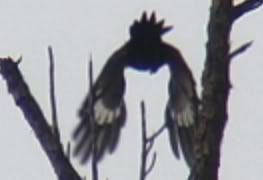
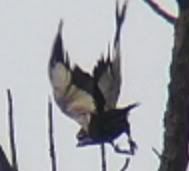
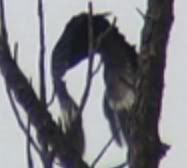
The fatal flaw is that the model's wings are quite boardlike--fixed in shape and two-dimensional. An actual Pileated's wings are flexible in three dimensions, and within each flap, they drastically change shape.

Note the very different wing shapes in the first two pictures here.

Because of this flaw, an out-of-focus video of the Pileated model can't be usefully compared to the actual bird in the Luneau video.

Jerome Jackson speaks

Jerome Jackson gave a talk on the Ivory-bill in Collier Cty., Florida on Wednesday night. Afterwards, an attendee wrote this:
...he talked about how pilleateds double knock and call and that he finds the audio recordings that Cornell got in the big woods inconclusive. He says the video, is without a doubt a pilleated in not an IBWO. Next, he told us with a smile that he will be on NOVA Jan 10th giving his side of the argument and Dr. Fitzpatrick will give his. He questions the science that Cornell used and said they had to come up with something in order to get that 10 million in funding. He said that he hopes that it exists, but if it doesn't, we don't need the IBWO as an icon to sell conservation of the big woods. He didn't take any questions and quickly left the stage. The audience was very quiet after, kind of in shock not knowing what to say.

Thursday, December 08, 2005

Fleeing Pileated shows a lot of white

I regularly hear people say that the Luneau bird must be an Ivory-bill because it shows "too much white on the upstroke and downstroke".

The video available here shows a rear view of an ordinary Pileated--this bird also shows a lot of white on the wings, whether at the top or bottom of the wingstroke:


Wednesday, December 07, 2005

Compare three videos

On page 58 of "The Ivory-billed Woodpecker", James Tanner wrote of the Ivory-bill:
Usually the flight resembles that of a Pintail, straight with rapid wing-beats, a resemblance accentuated by the slender neck and tail.
Do you think the Luneau bird flies like a Pintail?

Personally, I think it flies a lot more like a Pileated. For one thing, the Luneau bird's wingtips are very high at the top of the wingstroke, like a Pileated but unlike a Pintail. (Of course, the exact wingtip positioning is easier to see on the videos if you step through them frame-by-frame, or if you "pause" them at various times).

Take a good look at these three videos and see for yourself:

Luneau bird

Pileated Woodpecker

Yellow-billed Pintail

The Pintails are not in powered flight throughout the entire video. However, the video shows a few flaps of powered flight as the birds fly to the left against a headwind, and it shows more powered flight as the birds turn to the right and fly away from the camera.

Note that I've tried to find some Northern Pintail video online, but have been unsuccessful so far. Please email me if you can help.

Circling the wagons

An anonymous source recently emailed me this:
There are large amounts of this whole thing that give many of us a 'bad feeling'. Cornell is being WAY too secretive, combative, and generally not adhering to the rules of modern science. Their absolute refusal to acknowledge inconsistencies is troubling.
I think it's no accident that Cornell answered surprisingly few questions at last summer's AOU meeting (four videos are here).

At the end of his presentation, Ken Rosenberg said he was hoping he wouldn't have time for questions; under direct questioning, he ended up revealing some very interesting abnormal Pileated information. Russ Charif and Ron Rohrbaugh evidently didn't take any questions after their presentations.

After his plenary, in my opinion, John Fitzpatrick also appeared a bit too eager to leave the stage without taking questions (watch the end of his plenary video and see if you agree). (After his presentation, you can hear him say to someone "Well, now, it's pretty late, want to not have questions?".)

"Birding is Not a Crime" reported that at last week's Field Museum Ivory-bill gala, there was also no question-and-answer session.

I previously wrote about Cornell's excessive secrecy here.

Tuesday, December 06, 2005

Gene Sparling, rock star?

I enjoyed this article from the Chicago Tribune:
The sighting launched headlines from Chicago to Calcutta, sent teams of scientists traipsing to Arkansas, led to more sightings-and turned Sparling into a sort of rock star of the conservation world.

"It's a humbling thing," allowed Sparling, who routinely signs autographs for a half-hour at a time after lectures.

"The most powerful thing for me is that I meet a lot of people that tell me, `When I heard the news, I had to pull the car over to the side of the road, and I cried.' "
I've previously written about Sparling's sighting here.

Search reports on Mary Scott's site

There are some new Ivory-bill search reports here.

This year, as in the past 60+ years, searchers continue to see lots of other woodpeckers, find intriguing bark scaling, and hear tantalizing double-raps, but have found no confirmed Ivory-bills.

Note that during a single Christmas break in 1940, Jim and Nancy Tanner enjoyed great looks at five different Ivory-bills.

Monday, December 05, 2005

Report from Chicago Ivory-bill presentation

At "Birding is Not a Crime", there's now an excellent report from last week's Field Museum Ivory-bill presentation. An excerpt:

One interesting thing was the total lack of emotion or movement from the Luneaus in the boat when the bird flies by. If I had thought I'd just seen an IBWO, I'd be jumping up and down and probably end up in the water. One detail that is much clearer on the blown-up video is the white on the bird's back, which I could never clearly see on the computer or even on television.
In Cornell's presentations, they show some carefully-selected frames that appear to show white on the bird's back, but I'm completely unconvinced that this white was present on the actual bird. I say that for two reasons:

1. I've studied the Luneau DVD frame-by-frame, and I see plenty of frames where the back looks entirely black.

2. If you watch the trees in the Luneau DVD, you can also see apparent white smudges on them that appear and then disappear.

Estimated probabilities

Regarding the Ivory-bill controversy, I've attempted to predict the future before. This time, I've attached some probability numbers to some predictions:

Probability that searchers in Arkansas will have numerous tantalizing glimpses of birds that could be Ivory-bills--100%

Probability that ARUs and searchers in Arkansas will detect numerous tantalizing kent-like calls--100%

Probability that ARUs and searchers in Arkansas will detect numerous tantalizing double-raps--100%

Probability that searchers in Arkansas will detect numerous examples of tantalizing bark peeling--100%

Probability that searchers in Arkansas will capture additional video clips blurry enough to be inconclusive--99%

Probability that the Cornell team will officially release additional inconclusive video--33%

Probability that some non-Cornell person will attempt a fairly high-profile hoax (using a fictitious story of a very impressive sighting record, a faked picture, a feather from a museum specimen, etc)--40%

Probability that searchers in Arkansas will capture definitive proof that the Ivory-bill lives-- less than 1% [changed from "less than 5%" on 12/19/05]

Probability that numerous "believers" will eventually argue that the 2004 Arkansas Ivory-bill was the last of his kind--90%

Probability that one or more formal critical papers will be published by July 1, 2006--90%

If a critical paper is published, probability that numerous people will then reveal that they were privately skeptical all along--99%

Probability that the birding public will be much less confident of the Ivory-bill rediscovery story by July 1, 2006 than they are today--90%

Sunday, December 04, 2005

Harrison: "too many people in the swamp"

Regarding the Ivory-bill, has the "not enough observer coverage" problem morphed into a "too much observer coverage" problem?

Bobby Harrison now says this:
Harrison said the fact that extensive searches have turned up few sightings is because there are too many people in the swamp.

"There are too many people and too much noise," he said, explaining these birds are extremely wary.

An information cascade

I think it's fascinating that a group of intelligent, experienced people could publicly announce the "Ivory-bill rediscovery" given such flimsy evidence. I think it's likely that definitive proof will never come, and this high-profile case seems a likely candidate to be written up as a groupthink "case study" in future textbooks.

This 28-minute podcast by James Surowiecki doesn't mention the Ivory-bill, but I think it sheds some light on the psychology of the team.

To me, it seems very likely that team members were highly influenced by an "information cascade" as discussed in these two podcast excerpts:

Podcast excerpt 1
Podcast excerpt 2

Specifically, once the team became convinced an Ivory-bill was present, low-quality glimpses were considered "robust sightings" of the Ivory-bill; each of those sightings then further pounded in the idea that "there's an Ivory-bill here".

Even among strong "believers", I doubt that any single piece of evidence (sightings, video, audio recordings, bark peeling etc) was convincing on a stand-alone basis. However, as part of a swelling "information cascade", the weak individual pieces became convincing.

I've previously written about groupthink here.