Saturday, December 17, 2005

Blue Jay calls a good match for ARU "mystery bird"

Back in October, I wrote this:
I have learned from an anonymous source that the ARU cuts trumpeted as being a good match for an Ivory-billed Woodpecker (and reported as such in a letter to Science in early September) are more likely of Blue Jays. Moreover, the sound collection at Cornell has several cuts of Blue Jays that seem to match, or at least account for, the sounds recorded on the ARUs.

Although in their own collection, it appears that these Blue Jay cuts were not examined before the Cornell team sent their latest offering to Science. Rumor has it that the Cornell team has since analyzed these Blue Jay cuts and acknowledged that they are a good match.
I now have one of those Blue Jay cuts on CD, and, it is indeed a good match for the ARU cuts. If you'd like to get a copy of the cut yourself, fill in the Cornell web form by asking for Blue Jay cut LNS #13453. You'll have to pay for the CD and processing time, but the total cost likely won't come to more than about $30.

Cut #13453 is 34 seconds long--the "ARU-matching" Blue Jay calls start at about the 19 second mark...

Friday, December 16, 2005

Jerome Jackson commentary forthcoming

This just caught my eye:
The January 2006 issue of the top-tier ornithological journal, AUK, will publish a 15 page commentary about the recent Ivory-billed Woodpecker rediscovery by Jerome Jackson, an expert on this species. It should be interesting to read, so keep your eyes open for it.

Criticism of the journal 'Science'

Here's a blog entry critical of the journal Science (the bold font is mine):
Yet Science seems to have become as interested in garnering headlines in the popular press as in publishing solid research--perhaps, more. Twice in June 2005 alone, it played up stories that subsequently proved suspect--a June 3 article purporting to prove the ivory-billed woodpecker alive in an Arkansas swamp, offering what later proved inadequate proof, and then Hwang.

The race for fame and glory skews science no less than the arts and literature or sports. That individuals and publications, like Science, feel they must engage in it to prove their worth--and do so to the exclusion of all other values is a sad commentary on society--and on them.

Silencing the "heretics"

Back in July, the New York Times said this about David Sibley:
He has been reluctant to speak publicly about his doubts, and described doubters as being treated as "heretics" in online discussions.
In the same article, Kenn Kaufman said:
...we could have a more honest discussion if people accept the fact that we don't have proof."
Well, several months have passed, and skeptics are still being treated as heretics in online discussions at BirdForum, which claims to be "The Net's Largest Birding Community Dedicated to Wild Birds".

Here's my evidence:

1. Take a look at this link to BirdForum as of August 4 (I am user hgr389, or "HGR" on BirdForum):

In post #224, a user says:
My thanks to HGR for providing a series of well-thought out and provocative posts, based on quite sound logic.
Ok, so why is this notable? It's notable because, without telling me, someone at BirdForum has deleted my entire series of "well-thought out" posts. (If you're interested, those posts live on in Google's cache--here's an example).

Now, maybe BirdForum folks will try to justify these deletions because I posted links to my blog. That excuse won't wash, however, because to this day, I see plenty of (un-deleted) BirdForum posts that contain links to "believer" Ivory-bill blogs.

2. The Birdforum rules state: "We will remove posts that are abusive, disruptive, or out of context."

I think the above statement would be more accurate if this was added "...unless we disagree with your assessment of the Ivory-bill evidence. In that case, if abusive posts are directed at you, we will allow or even encourage them".

A few weeks back, an abusive individual showed up on the BirdForum "Debate: Evidence for the Survival of the Ivory-Billed Woodpecker". This individual stated that he saw "no reason to debate this woodpecker" and repeatedly posted off-topic ad hominem attacks.

On his blog, he wrote:
[BirdForum moderator KCFoggin, a believer] has no issues with me attacking Tom and Buck [my brother] because well she wrote "they deserve it for being so damn arrogant with those that wish to counter their opinions".
Even a pure "believer" joined in the criticism of KCFoggin's behavior:
I have to agree that the moderators need to step in here. I do not feel that Buck or Tom have really crossed any big lines here...[the above individual] has done nothing but used personal attacks. I don't understand why no action has been taken.
3. I eventually tired of the ad hominem attacks and took a break from BirdForum. Upon my return a few days ago, I found that without explanation, the administrators have banned me from posting!

Overall, I think this performance by the moderator(s) at BirdForum is nothing short of disgraceful.

Thursday, December 15, 2005

Big problems with those kent-like calls

Cornell has provided some good "kent call" information here.

In my analysis of the data at the link above, I see a couple of major reasons that these calls were almost certainly not produced by Ivory-bills.

1. First, compare the spectograms.

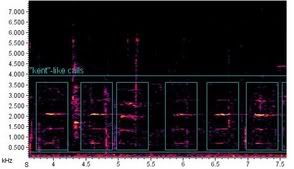
Here's the spectogram for the January 29, 2005 ARU recording:


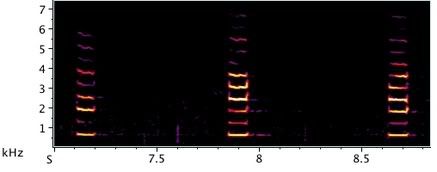
Here's the spectogram for an actual 1935 Ivory-bill recording:


The two spectograms just don't match. One big difference is the duration of the individual notes--in the case of the 1935 Ivory-bill, the notes are consistently about .1 second long; in the ARU data, the notes are much longer (more like .2 or .3 seconds in length).

Another large difference is the number of overtones or harmonics shown above the 2khz range in the Ivory-bill recording. These overtones or harmonics account for the far richer quality of the Ivory-bill notes (this is especially apparent if you use a good set of headphones as you listen on your computer). A third difference is the slight downslurring/upslurring ("U" shape) seen in the Ivory-bill notes but not in the ARU notes.

Now, I know that Cornell tried "degrading" the original Ivory-bill calls by broadcasting them through foliage at 145 meters, then re-recording them. If you're interested, you can check out those results here.

I'm not impressed with that approach--it's like trying to match a uselessly fuzzy "bird" photo with a uselessly fuzzy photo of an Ivory-bill model.

2. Here's the other major reason that I believe the ARU calls are not Ivory-bill notes: in both examples, the ARU birds hit some "sour notes" not present in the actual Ivory-bill recording.

Here's a link to the sound and spectograms for the January 31, 2005 kent-like calls. This bird produces two downslurred "sour notes" (at the 11 second and 18 second marks) that sound very much unlike the Ivory-bill's kent notes. The final note (at the 18 second mark) sounds to me like a fairly typical Blue Jay note.

Here's a link to the sound and spectograms for the January 29, 2005 kent-like calls. As in the January 31 example above, this bird hits a downslurred "sour note" (at the 5 second mark).

I've previously written about the ARU kent-like calls here.

I think this note from Cornell's web site is also interesting:
Some observers in Arkansas have been surprised to hear Blue Jays making purely "kent"-like calls for extended periods.

Wednesday, December 14, 2005

Why don't we have better photos?

Here's an excerpt from an Ivory-bill Q and A page on Cornell's site:
Q. Why don’t you have better photos of this bird?

A. The Ivory-billed Woodpecker moves frequently and covers long distances, perhaps up to 10 miles in a single day. Additionally, it is skittish and elusive. Locating centers of activity can be difficult. Thus, most observations are made while the bird is on the wing flying through dense forests, which makes photography a challenge. An objective of this year’s search is to find roost or nest cavities that would facilitate better documentation and study of the bird.
I find this explanation very unsatisfying. For one thing, we have no evidence that Ivory-bills routinely traveled 10 miles per day. Note that on page 32 of "The Ivory-billed Woodpecker", Tanner wrote "...in the Singer Tract a pair of Ivory-bills in the nesting season ranged over from three to four square miles".

The reason that the observations are uniformly lousy looks? I think the observed birds have almost certainly been seen very well on many other occasions, but every single time a bird is seen well (or clearly photographed), it's not an Ivory-bill. Here's a classic real-world example.

(Note to my long-term readers--of course, in current posts you'll often see points that I've made previously. This is mostly a concession to new readers, since it's unreasonable to assume that they've read and understood all of the older posts).

Tuesday, December 13, 2005

Reporters in the Bayou

According to this article, a number of reporters and photographers are "in the field" in Arkansas right now:
From December 12-14, about two-dozen media outlets have their reporters and photographers in Arkansas for an up-close, in-the-bayou experience of what it’s like to be searching for an Ivory-billed Woodpecker...Some of the media outlets plan to do longer, feature articles on the 2005-2006 search, so be on the lookout for more in the days ahead!

Henderson: "7,000 hunters in this same area"

Here's a very interesting snippet from this article:
In this [the search], too, hunters are allies, according to Scott Henderson, director of the Arkansas Game and Fish Commission.

"The deer hunter and the duck hunter out there are some of the best eyes and ears we‘ve got," Henderson said. "We have 7,000 hunters in this same area for eight hours at a time or more in some cases."
Using those estimates, that's 56,000 hours of coverage per day in the area. I think the odds are vanishingly low that the Ivory-bill could escape the notice of that crowd. (Remember, we're told that this bird was so spectacular that upon seeing one, people would drop to their knees and shout "Lord God")!

This fall in particular, given the massive Ivory-bill publicity, billboards, signage, etc, it's even more unlikely that an Ivory-bill could escape notice. I think it's very likely that there's been no living Ivory-bill in Arkansas since well before most of today's searchers were born.

Reuters article

From this Reuters story:
This is the first winter searching season since the ivory-bill's media splash in April. Back then, bird experts were at pains to describe the magnitude of the discovery. The Audubon Society's senior ornithologist, Frank Gill, said then, "It's kind of like finding Elvis."
Or at least an Elvis impersonator.
In addition to visual evidence, automatic audio recorders posted at various locations have picked up the distinctive call and double-knock tap of the ivory-bill.
Yep, it's distinctive all right. When you hear that ol' distinctive kent call, you can be certain that there's an Ivory-bill nearby!

Well, maybe not certain. It could be a Blue Jay. Maybe a Red-breasted Nuthatch, or possibly a White-breasted Nuthatch. Or maybe a Snow Goose, or a Wild Turkey, a Red-winged Blackbird, a Common Moorhen, an American Coot, or even a Great Blue Heron; or maybe a hunter's Blue-winged Teal call, or maybe someone playing an Ivory-bill tape.

If no one can prove that it's NOT an Ivory-bill, does that mean we have proof that it IS an Ivory-bill?

People have been hearing tantalizing kent-like calls in the US, thousands of times, for 60+ years. In zero percent of those cases, an Ivory-bill has subsequently been found in the area. In 100% of those cases, when the source of the sound was positively identified, it was something other than an Ivory-bill.

If you record a tantalizing kent-like call, by all means thoroughly search the area. If you find nothing, or if you find a Blue Jay making kent-like calls, please don't try to convince us that the recorded sound was "probably an Ivory-bill".
So far, he said, local residents had been supportive.

Signs describing the ivory-bill have weathered well in Arkansas, Andrew said. "We have signs that were put up in April that have not one bullet hole in them -- which is a reflection, I think, of the community's reaction to the bird."
He didn't mention this incident of suspected arson. Overall, I don't think the actions of arsonists/vandals necessarily reflect the views of the general public.

Monday, December 12, 2005

Groupthink illustration

In a small way, this article illustrates how groupthink may have caused Cornell to overweigh the significance of flimsy evidence (the bold font is mine):
Project manager Ron Rohrbaugh was the first to sit and listen [to a recorded double-knock]. When the knock filled the room, he nearly jumped up. Seeing Ron get that excited caused my heart to skip a beat. Before, we wanted to believe it was an ivory-bill; now it seemed it really could be one.
...
Fitz arrived shortly and sat in a chair facing the screen, head down, eyes closed, focused. After the double knock again filled the room, Fitz raised his head and looked around, uttering "Holy mackerel!" He didn't have to say much more: that reaction pushed our excitement off the chart.
Above, team members in the room allow themselves to be significantly influenced by the opinions of others, rather than relying on their own independent assessments of the evidence.

I think these admissions are also worth noting:
Because there are other sources that can make double knocks (branches, other woodpeckers, gunshots), it may be that we can never say with 100 percent certainty that any recorded double knock was made by an ivory-bill. The kent calls may be the only way to acoustically determine the presence of ivorybills. As of this writing we are trying to see if a Blue Jay could be the vocalist. We've heard Wild Turkey, Red-winged Blackbird, Common Moorhen, American Coot, and even Great Blue Heron calls that are deceptively similar to the ivory-bill recordings we have from 1935.

Sunday, December 11, 2005

Excerpts from Fitzpatrick's April speech

Here are some excerpts from John Fitzpatrick's speech at the Ivory-bill rediscovery press conference in April:
Gene led them around and they were unspeakably lucky because an Ivory-billed Woodpecker flew right in front of their canoe, and would have landed on their canoe had they not both shouted at it, simultaneously, "Ivory-bill!"
Question: If "Elvis" was evidently willing to land on a canoe containing two uncamouflaged observers, then why is this guy wearing a ghillie suit?
The video shows the large woodpecker, the diagnostic pattern of white in the wing, both wings having trailing white, the white on the back, and it even has a little image of a perched bird sitting on the tree that they wish they had seen before they came around that corner...
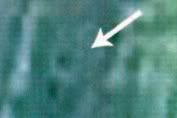
I disagree with everything after the "large woodpecker" phrase. Specifically, I think this little image isn't even a bird:


Fitzpatrick continues:
The program of research and conservation and agency involvement have gone on for a year. There are many mysteries that remain, tantalizing evidence of other birds, but not yet certain. We've surveyed a total of thousands of person-hours in an area about 5 percent of the Big Woods.
I think that 5% figure may be technically accurate, since Fitzpatrick said "surveyed" rather than "searched". However, this statement is misleading, as I noted here.