Ken Rosenberg of Cornell was on NPR's Science Friday show yesterday. The archived audio is currently available here.
You should listen to the audio and form your own impressions, but to my ear, neither host Ira Flatow nor Rosenberg himself sounded completely sold on the rediscovery story. For example, Flatow talked about the Ivory-bill that "supposedly" has been spotted, and Rosenberg sometimes used the past tense when talking about the Ivory-bill.
Rosenberg played some ARU kent calls, failing to mention that several searchers reported hearing and seeing blue jays making sounds very much like this in this area. Afterwards, he said "...we, um, believe they may very likely be an Ivory-billed Woodpecker". I think his tone and delivery belied his words.
I also thought it was interesting that Rosenberg referred to the rediscovery story as starting "about a year ago", in early February 2004. Another notable tidbit was his referring to Cornell's sight records as "well-documented".
Saturday, December 24, 2005


Baloney detection kit(s)
Here are links to a couple of interesting "Baloney detection kits":
1. Carl Sagan's
2. Michael Shermer's
These kits are suggested as "tools for testing arguments and detecting fallacious or fraudulent arguments". They can be used as an aid in discriminating between science and pseudoscience.
1. Carl Sagan's
2. Michael Shermer's
These kits are suggested as "tools for testing arguments and detecting fallacious or fraudulent arguments". They can be used as an aid in discriminating between science and pseudoscience.
Friday, December 23, 2005
Another high-profile 'Science' paper withdrawn
If something gets published in a prestigious journal like Science, does that mean it's necessarily true?
Here is more evidence to the contrary:
Here is more evidence to the contrary:
Woo Suk Hwang, the South Korean cloning scientist who publicly admitted in late November to having obtained human egg cells unethically, has now also moved to have his initial paper withdrawn because many of the scientific achievements claimed within it are false.Check out this paragraph:
Hwang has now admitted that the paper he co-authored had "fatal errors" in it, and that the prestigious journal Science should withdraw it...
Roh, who was one of the co-authors of the paper in Science, has now also admitted that he was not even aware of the paper until it appeared in the journal. Roh justified the fact that he authored a paper he was not aware of by stating that "security concerns" demanded such secrecy even within the group of authors.
Objective: Obtain irrefutable evidence
Here is a notable paragraph from a recent Washington Post article (the bold font is mine):
Shouldn't these T-shirts say something like "Possibly found!"?
But scientists such as Cornell's Ron Rohrbaugh, who directs the ivory-billed woodpecker research project, have a more urgent task. Rohrbaugh lists it at the top of his PowerPoint presentation on the group's objectives: "Relocate the bird and obtain irrefutable evidence."Isn't that an admission that we don't already have irrefutable evidence? If we don't have irrefutable evidence now, then I don't understand the "dead solid confirmed" announcement in April, with the resultant massive media splash that moved many to tears...
Shouldn't these T-shirts say something like "Possibly found!"?
Thursday, December 22, 2005
Debating through blog entries and comments
Now that those ridiculous moderators at BirdForum have essentially squelched relevant debate on their site, more Ivory-bill debate has moved to blog entries and comments.
Here's a good example: a believer post here, followed by (at the moment) a couple of skeptical comments here.
Here's a good example: a believer post here, followed by (at the moment) a couple of skeptical comments here.
Summing it up
I think a commenter on this blog most likely hit the nail on the head with this single sentence:
At the end of this search season, I think most people are realizing that Cornell won't have "the photo," and the reason they won't get the million dollar shot isn't that Tanner was wrong or these birds have become quiet or they've become wary or the terrain is so brutally tough, it's that there's no Ivory-bill to photograph.
Ivory-bill/Cougar parallels
A reader emailed me this:
Those two cats sure look like house cats to me. This analysis seems quite sensible.
The [Michigan] cougar nonsense is directly responsible for me becoming a "hardened skeptic", as described by others. Blurry videos and photos are stock in trade in the cougar baloney world, so I was instantly suspicious when I saw the ridiculous blurry IBWO video. I know the drill, and the IBWO and cougars in Michigan phenomena follow the same pattern. If you have a broadband connection, and want a good laugh, download their video. How anyone can claim that obvious house cats are cougars is simply beyond me.I watched the entire video today (even though I have broadband, the transfer rate was very slow, and it took many minutes to download the 17-minute video). Just as in the Ivory-bill situation, you've got grainy footage and some very questionable analysis by "experts".
Those two cats sure look like house cats to me. This analysis seems quite sensible.
Wednesday, December 21, 2005
Jackson/Fitz on Nova scienceNow
Earlier, I posted this about Jerome Jackson and John Fitzpatrick giving their respective sides of the Ivory-bill argument on an upcoming NOVA show.
This "BoingBoing" item gives a bit more detail (the bold font is mine):
This "BoingBoing" item gives a bit more detail (the bold font is mine):
The fifth episode of a new PBS show called NOVA scienceNOW airs Tuesday, January 10, 2006, at 8 PM ET. The story lineup -- a look at planet Xena (yet another "10th planet" candidate), stem cell research workarounds, a pandemic flu "explainer," the un-extinct Ivory-Billed Woodpecker, and the rise in the number and intensity of hurricanes and the link to global warming, and vat-grown meat -- looks interesting.
Seven signs of voodoo science
Several readers have recently recommended the book "Voodoo Science" by Robert Park.
Here is the first paragraph of Amazon's Editorial Review of the book:
1. The discoverer makes his claim directly to the popular media, rather than to fellow scientists.
2. The discoverer claims that a conspiracy is trying to suppress the discovery.
3. The claimed effect is so weak that it can hardly be distinguished from noise.
4. Anecdotal evidence is used to back up the claim.
5. Ancient beliefs are cited in support of the new claim.
6. The discoverer or discoverers work in isolation from the mainstream scientific community.
7. The discovery requires a change in the understanding of the fundamental laws of nature.
Here is an article by Robert Park entitled "The Seven Warning Signs of Voodoo Science".
If you see any specific examples of "voodoo science" in the current news, please feel free to leave a comment...
Here is the first paragraph of Amazon's Editorial Review of the book:
Scientific error, says Robert Park, "has a way of evolving ... from self-delusion to fraud. I use the term voodoo science to cover them all: pathological science, junk science, pseudoscience, and fraudulent science." In pathological science, scientists fool themselves. Junk science refers to scientists who use their expertise to befuddle and mislead others (usually juries or lawmakers). Pseudoscience has the trappings of science without any evidence. Fraudulent science is, well, fraud--old-fashioned lying.Here are the seven warning signs of "voodoo science":
1. The discoverer makes his claim directly to the popular media, rather than to fellow scientists.
2. The discoverer claims that a conspiracy is trying to suppress the discovery.
3. The claimed effect is so weak that it can hardly be distinguished from noise.
4. Anecdotal evidence is used to back up the claim.
5. Ancient beliefs are cited in support of the new claim.
6. The discoverer or discoverers work in isolation from the mainstream scientific community.
7. The discovery requires a change in the understanding of the fundamental laws of nature.
Here is an article by Robert Park entitled "The Seven Warning Signs of Voodoo Science".
If you see any specific examples of "voodoo science" in the current news, please feel free to leave a comment...
Tuesday, December 20, 2005
Comparing the Luneau bird to a known Pileated
Here's an interesting email from a reader:
------
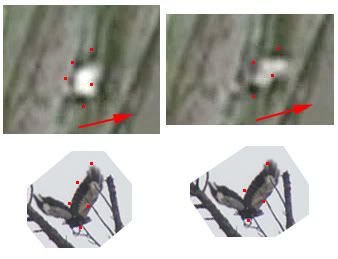
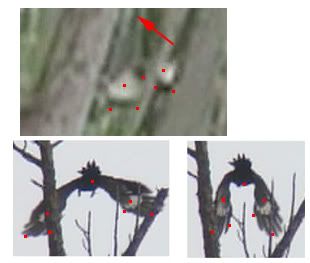
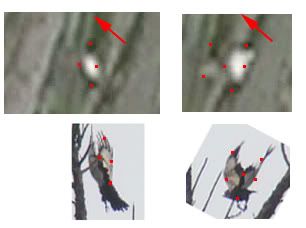
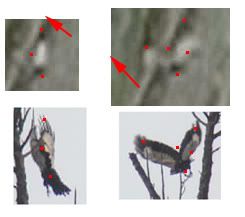
I did some screen captures of the manybirds.com Pileated video
and took some corresponding captures from the Luneau
video. I was looking for frames that showed the wing
pattern, which tended to be, in the Luneau video, at
the beginning of a downstroke. Looking at the Luneau
video (just the web Quicktime version--I don't have
the DVD), I can see several frames where what appears
to be a dark trailing edge to the woodpecker's wings
is visible. I can see corresponding frames in the
manybirds.com video of the Pileated. I was
particularly struck by a couple of frames where there
is an apparent dark "V" formed by the trailing edge of
the wings in the Luneau video. This is very prominent
in the manybirds.com video, which is, of course, in
focus.
I have done no editing to the web version of the
Luneau video--just captured and cropped individual
frames. For the manybirds.com video, I rotated some of
the frames and/or flipped them, to make the bird point
in a similar direction to the bird in the Luneau
video. I've also added little red dots, "reference
points" to what I think are corresponding parts of the
bird in each frame. The pattern of these should be
self-explanatory on the frames.
I will freely admit that this sort of thing is rather
subjective. Also, compression artifacts can cause
problems in digital video, and the fast motion of the
woodpecker's wings (both videos) and poor focus (Luneau
video) can really cause problems in interpretation.
The red arrow on the Luneau frames shows what I think
to be the motion of the bird at that time--it flies
right at first, then turns and flies up and away
angling to the left.
------
I did some screen captures of the manybirds.com Pileated video
and took some corresponding captures from the Luneau
video. I was looking for frames that showed the wing
pattern, which tended to be, in the Luneau video, at
the beginning of a downstroke. Looking at the Luneau
video (just the web Quicktime version--I don't have
the DVD), I can see several frames where what appears
to be a dark trailing edge to the woodpecker's wings
is visible. I can see corresponding frames in the
manybirds.com video of the Pileated. I was
particularly struck by a couple of frames where there
is an apparent dark "V" formed by the trailing edge of
the wings in the Luneau video. This is very prominent
in the manybirds.com video, which is, of course, in
focus.
I have done no editing to the web version of the
Luneau video--just captured and cropped individual
frames. For the manybirds.com video, I rotated some of
the frames and/or flipped them, to make the bird point
in a similar direction to the bird in the Luneau
video. I've also added little red dots, "reference
points" to what I think are corresponding parts of the
bird in each frame. The pattern of these should be
self-explanatory on the frames.
I will freely admit that this sort of thing is rather
subjective. Also, compression artifacts can cause
problems in digital video, and the fast motion of the
woodpecker's wings (both videos) and poor focus (Luneau
video) can really cause problems in interpretation.
The red arrow on the Luneau frames shows what I think
to be the motion of the bird at that time--it flies
right at first, then turns and flies up and away
angling to the left.
Pileated wing flare
Updated 2/15/06:
----------------
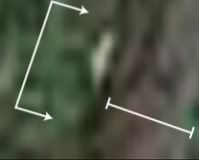
The first picture below is from the Luneau video (from Figure 1 in Cornell's paper).
The second picture below is from this page from Cornell's online Luneau video analysis.
Don Hendershot sent me an email noting that the "perched bird" in the Luneau video would have had to flash the interior of its wings as it left its perch, and the white of the perched bird in the first picture does roughly correspond to the interior of a Pileated's wing as it launches.
Jerome Jackson's January 2006 Auk article says that in his opinion, the "white shown extending from behind the tree is the large white patch present on the underside of the wing of a Pileated Woodpecker, held vertically, with the bird already in [full] flight."

----------------
The first picture below is from the Luneau video (from Figure 1 in Cornell's paper).
The second picture below is from this page from Cornell's online Luneau video analysis.
Don Hendershot sent me an email noting that the "perched bird" in the Luneau video would have had to flash the interior of its wings as it left its perch, and the white of the perched bird in the first picture does roughly correspond to the interior of a Pileated's wing as it launches.
Jerome Jackson's January 2006 Auk article says that in his opinion, the "white shown extending from behind the tree is the large white patch present on the underside of the wing of a Pileated Woodpecker, held vertically, with the bird already in [full] flight."
Monday, December 19, 2005
Plenty of "Ivory-bill" evidence in upstate NY
Previously, I wrote about the fact that you can gather plenty of "Ivory-bill" evidence even in areas far from that species' former range.
As an example, reader Dave Nicosia emailed me this:
As an example, reader Dave Nicosia emailed me this:
I saw a Pileated the other day in a deep forest of upstate NY...flying straight as an arrow! Had a lot of white on its wings too! Also saw quite a few dead trees with bark peeled back...some all the way to the ground and you could see where there were beetle or some other insect borings. There were also many big holes in select dead trees of this forest. I even heard a double rap. The double rap did come from close to where the Pileated flew which I thought was interesting. After hearing the Cornell double rap recordings, this sounded like a real double rap. It is hunting season up here so it could also have been a gunshot...
Point is I observed a lot of the things they are reporting in the "big woods" up here in the north woods. And we know there are just Pileateds up here.
Range Magazine Ivory-bill article
Here is a Range magazine article (PDF format) entitled "Ivory-billed Woodpeckers, UFOs, and Elvis":
Are we to believe that the same people who flock to a tiny, remote canyon of Big Bend National Park to record the much quieter, much smaller, and much less conspicuous Colima warbler for their life list would not be able to find a single ivory-billed woodpecker for 60 years?(Again, when I reference other people's words here, I'm not implying that I necessarily agree with everything they say).
Sunday, December 18, 2005
ABA: Ivory-bill status still "Extinct"
This is a very significant development (the bold font is mine):
"[The American Birding Association] Checklist Committee has not changed the status of the species from Code 6 (EXTINCT) to another level that would reflect a small surviving population. The Committee is waiting for unequivocal proof that the species still exists."
Prum: the evidence is "refutable"
There's some healthy skepticism in this article from the Houston Chronicle (the bold font is mine):
"We feel that if the bird has survived all this time, this has been a part of it," said Larry Mallard, the refuge's manager.I think that Richard Prum's return to public skepticism is notable. I wonder if the Wikipedia Ivory-bill entry will be updated, since it currently quotes Prum this way:
...
"The area is so finite, and the technology ... and the armies of people are so vast ... they will blanket the area to the point where it will be impossible to imagine if the bird is really there that it will elude this array of people," said Richard Prum, curator of ornithology at Yale University's Peabody Museum. Prum, intrigued by some of the recordings taken in Arkansas' Big Woods, said the evidence thus far is refutable.
"If they don't find it by this spring, they will have a lot of explaining to do," he said.
...
"Using traditional methods, we have some experience with how long it takes to find a rare bird ... and it is a lot less (time) than they are spending," Prum said. "With their new methods, with these unique methods, they are still not landing it. If the bird's there, they are going to find it."
...
Some of the most promising data collected to date come from White River. It was here where recordings of two supposed ivory-billed woodpeckers were taken this past January.
We were very skeptical of the first published reports, and thought that the previous data were not sufficient to support this startling conclusion. But the thrilling new sound recordings provide clear and convincing evidence that the Ivory-billed Woodpecker is not extinct.Prum's return to public skepticism could portend a re-submittal of his critical paper. Remember, back in September, a Nature article said this:
Even so, the three sceptics [Prum, Jackson, and Robbins] say that they withdrew their PLoS manuscript too hastily. They are getting support from other ornithologists, including Gary Graves, the Smithsonian Institution's curator of birds, who argues that the bird shown in the crucial video may be a pileated, not an ivory-billed, woodpecker.
Subscribe to:
Posts (Atom)


 Posts
Posts

