Saturday, July 08, 2006

More on that embarrassing "America's Amazon" claim

In this June '05 article, we see this from Scott Simon of The Nature Conservancy:
If the ivory-billed woodpecker was to make a last stand in North America, Scott Simon said the Big Woods of Arkansas was the perfect place.

"We think of it as the Amazon of the United States," he said. "A big, wild, impenetrable woods."
In my humble opinion, that comparison is ridiculous.

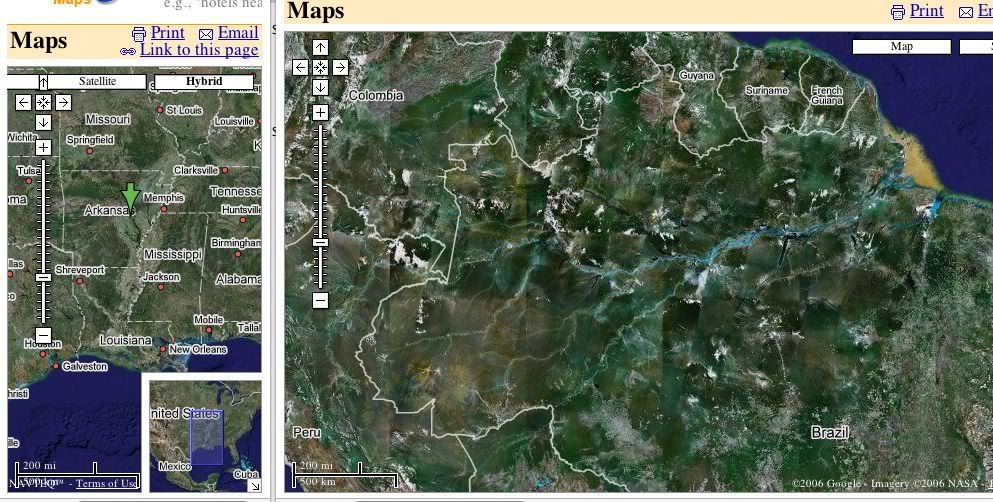
Hopefully, you can click to enlarge the picture below.


The picture compares Google maps (using roughly the same scale) of America's Amazon and the real Amazon. America's Amazon is that tiny sliver of green under the green arrow on the left side. The real Amazon forest is that thousands-of-times larger green blob on the right.

I previously wrote about this subject here.

Friday, July 07, 2006

"Crossing the Rubicon"

A May '05 email interview with Tim Gallagher is here.

An excerpt:
About John Fitzpatrick's statement that our lives were going to change, I think he was warning me that we were crossing the Rubicon, and there was no turning back. We were completely embracing the idea that the ivory-billed woodpecker still exists -- and putting our careers on the line. From that day on, we knew that this bird would be the focal point of our lives for years -- perhaps forever -- and it was a sobering thought.

Odd Aberdeennews.com story

An excerpt from this article:
Even though I respect both Mr. Sibley and Mr. Kaufman, I would like to view the tapes and then judge for myself. So would thousands, possibly millions, of birders and non-birders alike.

Thursday, July 06, 2006

Demanding a retraction from Cornell

Here is an excerpt from a recent comment on this blog (the bold font is mine):
It's time for all the gutless ornithologists and "bird ID experts" out there to stop mumbling and grumbling. RemFitzsenPatrick has had every opportunity to back off and say "we blew it." But all they do is continue to up the ante everytime they are attacked. How about passing a resolution at the fall NAOC stating the position that the Luneau video is not an IBWO, and demanding retractions of certain pubs? I don't understand why this should be allowed to just die down without some serious repercussions for the main proponents.

I believe that many of you are afraid that somehow, somewhere, a real IBWO is going to be found and then you'll look like idiots. A real rediscovery is not something to be afraid of, it's something to hope for, actually. But the AR "rediscovery" is a complete sham and should be treated as such.
Obviously, this whole mess is a monumental embarrassment to many conservationists and birders. I would argue that dragging this farce out is not really in anyone's long-term best interest.

Getting Cornell's ridiculous Science paper retracted would be a major first step in any recovery effort.

It seems that logic and tiptoeing around are not working, so what's the best way to force the issue? Is the "resolution at Veracruz" idea above a feasible one? Should respected birding names start openly calling for a retraction? Any thoughts are appreciated...

The ABA's not buying what Cornell's selling

In the current (July/August 2006) American Birding Association "Birding" magazine, there is an article by ABA Checklist Committee Chairman Bill Pranty. (As far as I know, this article is not available online).

On page 21, under a videograb from the Luneau video, the following text appears:
The Ivory-billed Woodpecker is currently classified as a Code 6 species ("cannot be found") by the ABA Checklist Committee. If definitive evidence of its occurrence were to be published and then evaluated by the Committee, the status of the species would be changed to Code 3 ("rare"). The bird in this videograb is judged by some authorities to be an Ivory-billed Woodpecker, but the Committee has not endorsed that judgment.
Elsewhere in the article, it says that current ABA Checklist Committee members are Bill Pranty, Jon Dunn, Steve Heinl, Andrew Kratter, Paul Lehman, Mark Lockwood, Bruce Mactavish, and Kevin Zimmer.

Wednesday, July 05, 2006

Some humor

1. The Wreck of the Lab-o-ra-tory

2. Some poetry and suggested book titles

3. BINAC's report from a volunteer Ivory-bill searcher

4. Cornell's Luneau video analysis.

5. Suggestions for sessions at this fall's AOU meeting.

6. Gallagher's Grail.

----------------------------------------------------


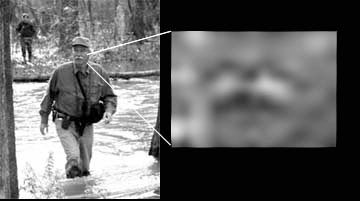
The inset above is a 10x bicubic resample of a portion of the original image.

(I'll put a link to this post somewhere under "links" on the right side of the page.)

Tuesday, July 04, 2006

No Ivory-bill presentations at the next AOU meeting?

It's only about three months until the next AOU meeting in Veracruz, Mexico.

Here is a link to the scientific program. I see some Cornell names there, but I don't see any mention of the Ivory-billed Woodpecker.

Can anyone out there predict what (if anything) will happen, Ivory-bill-wise, at that meeting?

Yet another Cornell version of the leak timeline

An excerpt from this Cornell University News Service release, dated May 4, 2005:
But on April 26 the news began leaking on the Internet.

Lab director John Fitzpatrick worked with the journal Science to revise the research paper on the sightings so it could be accepted and published by Thursday, April 28, on the Science Express Web site, to coincide with a press conference in Washington, D.C.

Monday, July 03, 2006

More detail on The Leak

John Trapp has more detail here.

I haven't yet looked this over very carefully, but Laura Erickson may have correctly transcribed John Fitzpatrick's version of the leak timeline here.

There is a slide detailing Fitz' version of the leak timeline in the video of Fitz' AOU plenary here, about 3/4 of the way through.

Update--here's a screen capture containing that slide:


I don't know what this all means, but it does seem odd that there are apparent discrepancies on two key points:

1. Was the original Science paper officially accepted on April 25 or 26?

2. Was "news of the discovery" actually posted on a nationwide listserv on April 25, as stated in Fitz et al's Auk rebuttal to Jackson's commentary? As far as I can tell, no such news was posted on a nationwide listserv until a BIRDCHAT posting on the evening of April 27.

Here is an excerpt from Fitz et al's Auk rebuttal (the bold font is mine):
Jackson is incorrect (p. 2) in stating that any of the project's confidants “made the information available ahead of schedule.” The remarkable fact is that the rediscovery was kept out of the public eye for 14 months by upwards of 200 individuals (researchers, volunteer searchers, donors, professional colleagues, personnel of The Nature Conservancy and the Cornell Lab of Ornithology, agency officials, family members, etc.). On the evening of 25 April 2005, an individual not involved in the search learned about it inadvertently and posted news of the discovery on a nation-wide listserv.

Jackson is incorrect in alleging that a “rapid path to publication for the Science article” (pp. 2, 8) compromised the peer-review process. Our article was fully peer-reviewed following standard editorial procedures, including requests by Science editors that reviewers act quickly. During this process, we made the video evidence available to editors and reviewers via a confidential web site. We submitted the article on 5 April and received official acceptance plus editorial and referee comments on 26 April. Coincidentally, the latter date was the same day that news of the rediscovery, accompanied by a host of inaccurate rumors, spread rapidly over the Internet following the previous evening's leak (see above). Inundated with inquiries from colleagues, the media, and the public, we nevertheless believed it inappropriate to make any announcement before the scientific article was published and the evidence made publicly available. On the afternoon of 26 April—after the paper had been accepted following normal procedures—the editorial staff at Science graciously agreed to expedite the article's publication, provided that we comply with the editorial changes required. We worked diligently to complete all revisions in time for release via Science Express on 28 April 2005. We remain indebted to the editorial staff of Science for their significant efforts in accommodating presentation of our paper immediately following its acceptance, thereby allowing open examination of the evidence essentially simultaneously with the public's learning about the discovery.
Just for the record, the following information appears on page 4 of Cornell's original Sciencexpress paper (the bold font is mine):
Supporting Online Material www.sciencemag.org/cgi/content/full/1114103/DC1
Materials and Methods
SOM Text
Acknowledgments
Figs. S1 to S6
Movie S1
References and Notes

8 April 2005; accepted 27 April 2005
Published online 28 April 2005; 10.1126/science.1114103
Include this information when citing this paper.
Post-doc opportunity

Check out this job posting (available here), dated June 27, 2006:
POST-DOC OPPORTUNITY at the USGS National Wetlands Research Center - Application of Remote-Sensing Imagery and Associated Models in the Recovery Planning for the Ivory-Billed Woodpecker. The Ivory-billed Woodpecker, long suspected to be extinct, is now known to persist in remnant lowlands of the Cache River, Arkansas. Planning efforts are in progress for extensive searches to find more birds in Arkansas and other river bottoms of the Southern US. Anecdotal reports of Ivory-billed Woodpeckers in the southern US continue to this day. Geographic areas where potential ivory-bill habitat may exist is vast throughout the southeastern US and Gulf of Mexico coastal areas. Research opportunities are available to develop methods for the integration and operation of remote-sensing resources with ground data and other ivory-bill habitat analyses to identify and characterize a range of potential suitable habitat for the Ivory-billed Woodpecker. A team of forest ecologists, ornithologists, and geographers at the National Wetlands Research Center conducts a variety of avian habitat investigations, and works cooperatively with the Lower Mississippi Valley and Gulf Coast Joint Ventures. Project activities will be conducted in collaboration with the Ivory-billed Woodpecker Recovery Plan--particularly, the Planning and Assessment Framework. The recovery team has identified several primary challenges: (1) how can we develop useful models of ivory-bill habitat relations, (2) how can the US Fish and Wildlife Service and others predict and evaluate the effects of forest management on potential ivory-bill habitat, and (3) the need to develop spatial models that integrate remotely sensed data bases to study the distribution of potential suitable habitat. Outcomes of meeting these challenges will include new knowledge of Ivory-billed Woodpecker habitat relations, facilitation of rapid and efficient search protocols for ivory-bills, contributions to useful forest inventory and monitoring procedures, and development of predictive models to inform decisions on forest management. The primary need is the development of methods to produce maps of forest structure, forest composition, and forest health (dead/dying trees) with GIS and remote sensing imagery/data at multiple scales and resolutions for regional, landscape, and local applications. Model output should be in the form of variables whose values can be measured in the field during forest inventories. Variables derived from digital imagery and data from LIDAR, ALI, Landsat, Hyperion, AVIRIS, and aerial photography will be provided by USGS. Interested applicants should contact WYLIE BARROW, USGS-National Wetlands Research Center, Lafayette, LA (PH: 337-266-8668; EM: wylie_barrow AT usgs.gov), or LARRY HANDLEY, USGS-National Wetlands Research Center, Lafayette, LA (PH: 337-266-8691, EM: larry_handley AT usgs.gov). For application details, see [this link].

Sunday, July 02, 2006

Dunn vs. Dunne

In John Crewdson's May Chicago Tribune piece, we see this:
"I've never seen such awful documentation on any record. I just look at the video and say, `God, it's hopeless.' It's hard for the human being, in such high-profile cases, to just relax and say, `Well, maybe we made a mistake.'"

-- Jon Dunn, field ornithologist and chief consultant for the National Geographic Field Guide
According to Laura Erickson here, Pete Dunne has a very different view. An excerpt:
I have seen the evidence. I accept the eminient plausibility. Most of all, I accept the eyewitness accounts of birders whose skills, judgment, caution, and integrity I trust. It is less correct to say that I believe in the existence of the Ivory-bill than to say I accept its existence based upon the evidence and testimony presented.
Outside of Fitz et al, I think the vast majority of birding experts side more with Jon Dunn than Pete Dunne at present. What is Pete Dunne thinking?