>Jackson’s Auk article is a sober assessment of the situation.Every attempted defense of their original colossal error is making things worse, much worse. This is truly painful to watch.
>
>Dan Purrington
Dan/LABIRD: before you put too much stock in
Jackson's article, note that that authors of the
original Science paper (including me) have a
separate paper in press in the next Auk that
dissects virtually every point made by Jackson.
The number of factual errors in Jackson's piece
is astonishing, and we wonder why the Auk did not
do at least some basic fact-checking before
publication. Further, its "conspiracy theory"
innuendos are offensive to all who took part in
the Arkansas search.
--
Van Remsen
najames AT LSU.edu
LSU Museum of Natural Science
Friday, March 31, 2006
Digging in, deeper and deeper
From the Louisiana Birding List today:


"A wonderful, wonderful, wonderful experience"
I don't know how I missed this previously, but here is another "update" from Cornell's web site, dated March 1, 2006.
A couple of excerpts (the bold font is mine):
A couple of excerpts (the bold font is mine):
[Deputy Secretary of the Interior, Lynn] Scarlett said, “I’d like to thank the Cornell Lab of Ornithology for their great science work that has made the research possible here and that has helped us to confirm the sighting of the Ivory-billed Woodpecker.”
...
“This morning we had a chance to paddle in some of those bayous and among those trees, and even without the bird, it is a wonderful, wonderful, wonderful experience.
Thursday, March 30, 2006
American Bird Conservancy position
Regarding the "Ivory-bill", the American Bird Conservancy evidently has gone "on the record" as quoted here.
I agree with very little of this paragraph:
I agree with very little of this paragraph:
The principle investigators from the Cornell Lab of Ornithology and their colleagues have been thoroughly professional in the scientific rigor with which they have been conducting surveys, analyzing data, and presenting results. The video evidence was presented in Science, one of the most reputable of peer-reviewed journals. Additional analysis of historical information and audio evidence has been thorough. The investigators’ actions have been transparent and all of this information is available to the public. Jackson’s criticisms of the work are not supported by the available scientific evidence and editors of The Auk apparently did not follow standard scientific review procedures.
The road to fraud
On page 10 of his book "Voodoo Science", Robert Park writes:
Why do I say that? For now, here are just a few specific reasons:
1. Cornell's rejection of Sibley's so-called "wing-twisting hypothesis" is nothing short of astonishing.
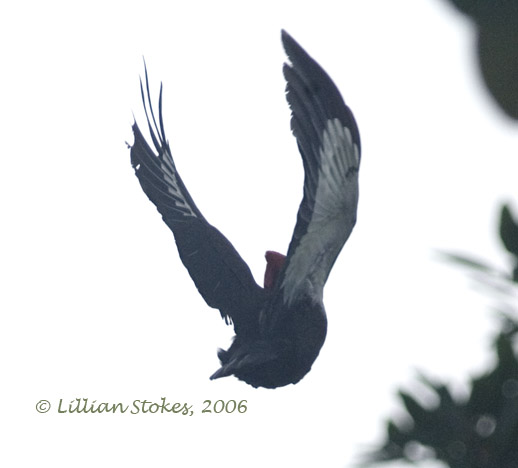
A Pileated's wing-twisting is not a "hypothesis"; it is an indisputable fact. This fact is borne out by clear photographic proof right in Sibley's paper (see the manybirds.com Pileated); yet another good example is on the Stokes Birding Blog here.
In the face of the clear photographic proof of Pileated wing-twisting, Cornell's continued defense of their stiff-winged "model" birds is preposterous.
2. As I mentioned here recently, Cornell is currently using a bogus "wingbeat frequency" argument; what's more, they must know that their claim is bogus. I don't see how anyone can actually see anywhere near 38 wingbeats in the Luneau video, regardless of the amount of "Ivory-bill Kool-Aid" consumed.
3. Cornell's illustration of the Luneau bird's position (see below) is completely and utterly absurd. Cornell's illustration is in the middle (from Figure 2 of Sibley's rebuttal paper).

I fail to see how any knowledgeable person could still defend that drawing, given the clear portrayal in Sibley's paper of the bird's actual position and movements.
4. Cornell's proposal and defense of the "six-pixel bird" is ludicrous. In their response to Sibley's paper, they now actually claim that this "bird" is "leaning away" from the trunk!! (the bold font is mine):
What may begin as honest error, however, has a way of evolving through almost imperceptible steps from self-delusion to fraud. The line between foolishness and fraud is thin.And on page 211:
...But most of the scientists and inventors we met started out like Joe Newman, believing that they had made a great discovery overlooked by everyone else. While it never pays to underestimate the human capacity for self-deception, they must at some point begin to realize that things are not behaving as they had supposed.Unfortunately, I think Cornell is now headed directly down the road to fraud.
Like all those who have gone down this road before them, they will have reached a fork. In one direction lies the admission that they may have been mistaken. The more publicly and forcefully they have pressed their claim, the more difficult it will be to take that road. In the other direction is denial. Experiments may be repeated over and over in an attempt to make it come out "right," or elaborate explanations will be concocted as to why contrary evidence cannot be trusted. Endless reasons may be found to postpone critical experiments that might settle the issue. The further scientists travel down that road, the less likely it becomes that they will ever turn back. Every appearance on national television, every new investor, every bit of celebrity and wealth that comes their way makes turning back less likely. This is the road to fraud.
Why do I say that? For now, here are just a few specific reasons:
1. Cornell's rejection of Sibley's so-called "wing-twisting hypothesis" is nothing short of astonishing.
A Pileated's wing-twisting is not a "hypothesis"; it is an indisputable fact. This fact is borne out by clear photographic proof right in Sibley's paper (see the manybirds.com Pileated); yet another good example is on the Stokes Birding Blog here.
In the face of the clear photographic proof of Pileated wing-twisting, Cornell's continued defense of their stiff-winged "model" birds is preposterous.
2. As I mentioned here recently, Cornell is currently using a bogus "wingbeat frequency" argument; what's more, they must know that their claim is bogus. I don't see how anyone can actually see anywhere near 38 wingbeats in the Luneau video, regardless of the amount of "Ivory-bill Kool-Aid" consumed.
3. Cornell's illustration of the Luneau bird's position (see below) is completely and utterly absurd. Cornell's illustration is in the middle (from Figure 2 of Sibley's rebuttal paper).
I fail to see how any knowledgeable person could still defend that drawing, given the clear portrayal in Sibley's paper of the bird's actual position and movements.
4. Cornell's proposal and defense of the "six-pixel bird" is ludicrous. In their response to Sibley's paper, they now actually claim that this "bird" is "leaning away" from the trunk!! (the bold font is mine):
Contrary to the interpretation of Sibley et al.(2), the black and white object apparent in the Luneau video 26 s before the bird flies is consistent in size (35 to 45 cm), shape (vertically elongate, leaning away from the trunk), and pattern (black with white central patch) with a perched ivory-billed woodpecker...
Wednesday, March 29, 2006
Skepticism on ID-Frontiers
In the recent Ivory-bill discussion on ID-Frontiers, someone recently posted this sentence:
Actually, no. The sentence is notable because it was written by John Puschock, listed as a full-time member of the Cornell search team for the '04-'05 season, and back again this year as a "scout" for the search team. John's full ID-Frontiers post (which is, of course, not entirely skeptical) is here.
There's more about Puschock in an old article here:
But how the hell could they go this long without being seen well and conclusively photographed?We can safely assume that the writer is just another one of those "trolls" who probably hates conservation and/or is funded by the evil Arkansas Duck Hunting Cabal, am I right?
Actually, no. The sentence is notable because it was written by John Puschock, listed as a full-time member of the Cornell search team for the '04-'05 season, and back again this year as a "scout" for the search team. John's full ID-Frontiers post (which is, of course, not entirely skeptical) is here.
There's more about Puschock in an old article here:
Now that he's home and the entire world knows about the rediscovery, Puschock says it was an honor to have been part of the search. "The combination of the secrecy and media interest made it feel like you were a combination of a CIA operative and rock star. Well, that's an exaggeration, but it's the closest you're going to get as a wildlife biologist."
Schedule changes for OOS annual meeting?
I just received this email from an anonymous person:
4/4/06 update: Jim McCormac, OOS President, emailed me to say that Hoose and Kaufman ARE still on the schedule for this event. It appears that some recent mailings were erroneous.
The Ohio Ornithological Society has apparently dropped both Phillip Hoose and Kenn Kaufman from their April annual meeting – or the two pulled out. Info on the web (PDF format) and in their initial mailing had both as featured speakers. Recent mailings have listed local bird experts in those spots talking about local birds and keeping things safe – which I applaud.
The reasons for either Hoose or Kaufman being dropped or dropping out might be interesting but nothing I have any insight into.
4/4/06 update: Jim McCormac, OOS President, emailed me to say that Hoose and Kaufman ARE still on the schedule for this event. It appears that some recent mailings were erroneous.
Tuesday, March 28, 2006
Monday, March 27, 2006
Article on Bobby Harrison
From this article:
He's just part of a number of teams out in the Cache River National Wildlife Refuge and eastern Arkansas looking for the bird, so why hasn't anyone got the pictures?
"I think there may be too many people searching for it," Harrison said. "This bird is extremely wary."
He's confident, though, that more and better evidence will come. Based on individual, unconfirmed reports from hikers and hunters, he said, ivory-billed woodpeckers are probably hiding out in Florida, South Carolina and elsewhere in the Southeast.
Bad information
I previously linked to this post from Laura Erickson, but I want to point out that she is repeatedly making a critical claim that is categorically untrue (the bold font is mine):
Each sound recording we have could arguably have been made by something else, too, but since the possible Ivorybill recordings were clustered in the same areas as the sight reports, although the ARUs and search teams were located more randomly, I'd say there's a better than even chance that at least some of the sound recordings really were of an Ivorybill.The "clusters" of "tantalizing" sound recordings were NOT obtained anywhere near the Cache River "hot zone" where the fleeting glimpses occurred--the typical recording locations were more like 50 to 80 miles away (in the White River area).
Top 10 Most Endangered Birds
Audubon's Report on America's Top 10 Most Endangered Birds is now out. Listed first in the report (PDF format) is the Ivory-billed Woodpecker.
Like me, you may strongly favor efforts to protect endangered birds known to actually exist. If so, you may cringe to see the Ivory-bill listed here--it's not unlike placing Bigfoot front-and-center on a list of America's most endangered mammals.
Note that for each of the other nine species on the list, color photos are provided. For the Ivory-bill, only a color illustration is provided.
Audubon also helpfully provides a list of 10 "Myths and Facts" (PDF) about the Endangered Species Act.
Here is #4:
Like me, you may strongly favor efforts to protect endangered birds known to actually exist. If so, you may cringe to see the Ivory-bill listed here--it's not unlike placing Bigfoot front-and-center on a list of America's most endangered mammals.
Note that for each of the other nine species on the list, color photos are provided. For the Ivory-bill, only a color illustration is provided.
Audubon also helpfully provides a list of 10 "Myths and Facts" (PDF) about the Endangered Species Act.
Here is #4:
4. MYTH: U.S. Fish and Wildlife Service scientists frequently use “junk” or faulty and incomplete science which leads to incorrect listing and habitat designation decisions.
FACT: While any group or individual may petition the federal government to list a species as endangered or threatened, to succeed the petition must address several statutory listing criteria, be based on the best scientific data available and go through a series of rigorous reviews and peer review. As a result, decisions to list a species are rarely, if ever, reversed due to inadequate science. The same is true for habitat designation decisions. Overall, while there is seldom unanimous agreement among scientists, the science behind the decisions made under the ESA is rarely found to be inaccurate. A 2003 Government Accountability Office report found that only 10 of the more than 1,200 domestic listed species were delisted after new scientific information surfaced indicating that the original listing decision was not warranted.
Sunday, March 26, 2006
"We don't feel threatened"
From this Arkansas Democrat-Gazette article:
...Also at the conference, David Luneau, the University of Arkansas at Little Rock electronics professor who, almost two years ago, captured murky pictures of the bird with a video camera mounted on a milk crate in a canoe, defended his claim to have rediscovered the bird against recent scientific attacks.
Of an article in the journal Science that suggested Luneau may have in fact recorded the flight of a pileated woodpecker, a smaller bird that lacks the ivory-bill’s white wing markings, Luneau said, “We don’t feel threatened.”
Subscribe to:
Posts (Atom)


 Posts
Posts