Friday, October 28, 2005
Video of AOU Ivory-bill presentations now online
Thursday, October 27, 2005
The "awesome PR machine"
The PR is quite impressive--you've got Cornell team members making large numbers of personal appearances; they're also on TV and radio. You've got "The Grail Bird", you've got web sites, you've got fawning articles. You've also got press releases and tour hype. Throughout it all, a drumbeat message is "the Ivory-bill rediscovery is dead solid confirmed".
The public may be largely unaware that beneath the surface, there is a raging scientific debate. Because people desperately want to "believe", there is an undeniable stigma attached to expressions of skepticism, and because of that stigma, almost all skeptics have been publicly silent.
Right now, what does the public see that balances the "believer" PR machine? Not much. No TV, no radio, no books, no press releases, no personal appearances. You've got some skeptical comments in a few articles, you've got some skepticism on the internet, and that's about it.
Overall, the public perception on the "rediscovery" is still heavily influenced by emotion and PR, and lightly influenced by facts and logic. Over the next year, I think that facts and logic will begin to prevail.
Wednesday, October 26, 2005
New skeptical article from Don Hendershot
Since that time I have kept up with the ivory-billed saga through the Internet. I have discovered a very well reasoned blog questioning the rediscovery of the ivory-billed woodpecker. The blog is maintained by a Minnesota birder named Tom Nelson. Nelson asks simple but pertinent questions regarding the first ivory-billed quest and points out plausible – non-ivory-billed – explanations for much of the “proof” posited by the ivory-billed team. You can access the blog at http://tomnelson.blogspot.com/.Don Hendershot has previously written on this subject here and here.
Poor quality of Luneau video--a plus?
The [Luneau] film left no doubt. "It's not a clear, beautiful photo," Stotz said. "But when someone provides a clear, beautiful photo, people say, 'That's a fake.' Nobody would fake something this poor in quality."(As always, unless otherwise indicated, I've added the bold font.)
Tuesday, October 25, 2005
A slippery slope?
---
The Cornell experts have not completely ruled out the possibility—albeit slim—that the calls were those of jays, seen in the area where the sounds were retrieved.
---
People have been hearing tantalizing kent-like calls in the US, over and over, for 60+ years. In zero percent of those cases, an Ivory-bill has subsequently been found in the area. In 100% of those cases, when the source of the sound was positively identified, it was something other than an Ivory-bill.
So now Cornell has recorded some more kent-like calls (rumor has it, these calls may have been recorded 50 or more miles away from the area of the "robust sightings"). They've searched the area, and no Ivory-bill has been found. In the area, they have observed jays uttering long sequences of nasal tooting calls that sound like Ivory-billed Woodpeckers. On the recordings, Blue Jay sounds are heard within 5 minutes of the kent-like calls. Blue Jay recordings in their own collection appear to be a good match for the "mystery sounds".
If Cornell was to spin the possibility as "slim" that the calls were those of jays, I'd say they were headed down the slippery slope toward prevarication.
Monday, October 24, 2005
Pileated double-knocks
----
The Pileated Woodpecker does give a double-knock. This behavior has been known for many years; for example, here's a snippet from Short's 1982 monograph (p. 419) regarding "demonstration tapping" in the Pileated [my comments in brackets]:
"This form may occur as a double tap, akin to the drum taps that are characteristic of various species of Campephilus; such a double tap may be associated with copulation or may occur at a prospective nest site (Kilham, 1959d, p. 381). Such demonstration tapping is known in D. javensis and D. martius [a reference to the congeneric White-bellied and Black Woodpeckers]. Drumming takes place all year, but especially marks the prebreeding period, for example, in December and January [when CLO's ARU cuts were obtained] in Maryland (Kilham, 1959d). Bent (1939, p. 175) cites Sutton as indicating that a drumming burst may be followed by three distinct blows, thus resembling drum taps of Campephilus, but Hoyt (1957) did not thi[nk] these are typical, nor do I."
Cornell has a Pileated Woodpecker recording that is a clear double knock, indistinguishable to expert ears from a Campephilus. Nothing in the ARU cuts eliminates PIWO or, for that matter, a Red-bellied Woodpecker or Yellow-bellied Sapsucker, both of which "double knock" as well.
----
Again, if you collect 17,000 hours of audio data in an area containing Pileateds but no Ivory-bills, you should expect to hear a lot of double-raps.
Here's a previous post on the topic.
Sunday, October 23, 2005
Associated Press mentions the skeptics
Here's a snippet:
---
Skeptics remain, however, with Internet bloggers contending Cornell researchers probably spotted an abnormal version of the pileated woodpecker.
---
"Town ready to cash in on birders"
Here are some snippets, with my comments in red:
---
It doesn't take a lot of high-powered economic analysis to see why Mallard Pointe Lodge in Brinkley, Ark., doesn't cater to duck hunters the way it used to.
The ivory-billed woodpecker was spotted just a quarter-mile away from the 3,000-acre spread where Mallard Pointe, originally a duck hunting club, provided guides, dogs and open bars for hunters.
"We've set most of that aside and we have gone full force into bird watching," said manager Butch Turner.
I'm not sure that's a good move at this point.
The lodge finished a 10,000-square-foot addition last month that more than doubled its capacity. It signed up the biggest name in birding these days - Gene Sparling, the naturalist who first saw the ivory-bill in February 2004 - to lead some of its tours. Bird-watching packages for a seven-night stay cost $2,295 per person.
...
"They [birders] don't stay in tents when they travel," state tourism Director Joe David Rice was quoted in the Arkansas Democrat-Gazette. "They stay in fine hotels, drink wine and eat expensive meals."
Maybe some birders fit the Thurston Howell III demographic, but I don't know any of them. I do know a lot of birders that sleep in cheap motels or tents (or their cars).
---
"We are on a very cold trail right now"
Here are a few snippets, with my comments in red:
---
"It's frustrating, because we are on a very cold trail right now," said Ken Rosenberg, the lab's director of conservation science.
...
The skeptics withdrew the paper and said they were convinced the ivory-bill existed, after the Cornell lab sent them audio recordings that captured the bird's calls and knocks.
Inexplicably, Prum and Robbins did say they were convinced by the audio. Jackson remains publicly unconvinced.
Not everyone is convinced, and the debate continues on the Internet. One blogger, who identifies himself as an "avid Minnesota birder," maintains a Web site called "the ivory-bill skeptic" and contends the searchers probably spotted an abnormal version of the pileated woodpecker.
"I think the search team is so committed to their 'Ivory-bill' discovery that they can't be expected to do true objective, cold-hearted analysis of the evidence any longer," the anonymous skeptic said. "I think they've invested so much work and time into this project that expecting them to step back, take a fresh look and ask 'Could this really all be a mistake?' is asking way too much."
He's wise to remain anonymous. If he published his real name and email address, he'd probably be subject to some personal attacks these days. You certainly don't want your name attached to ideas that may be logical but unpopular.
Cornell ornithologists figure a systematic, strategic search is the best response.
...
This year's search, funded by $800,000 in private donations...
The article also says that last year's search cost was similar. If so, we're talking about $1.6 million spent on search costs alone. At some point, it may make sense to ask whether that money could be better spent on things like protecting habitat for birds that are known to exist.
Sleuthing for clues to a rare bird's existence turns out to be tough on morale.
"The work itself, on a day-to-day basis, is quite tedious," Rosenberg said. "It seems exciting, but what you're doing is sitting on a log, swatting mosquitoes and trying to stay awake."...
----
Friday, October 21, 2005
Huge, clown-like woodpecker videotaped
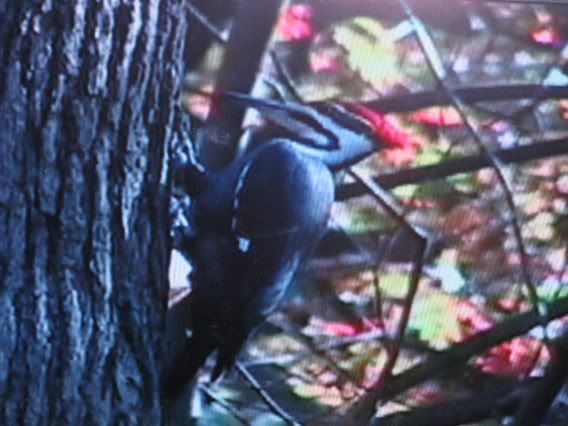
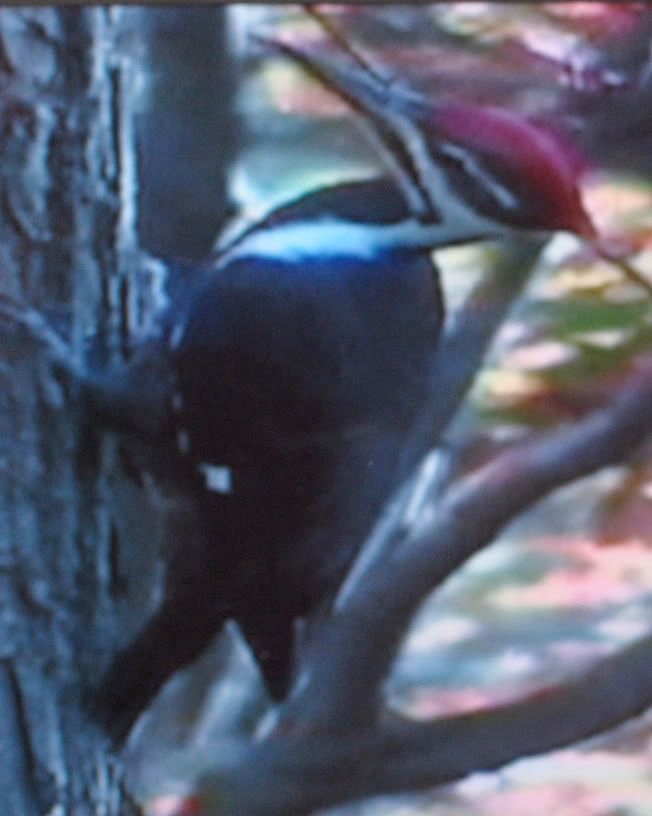
Not knowing an easy way to transfer this video to my Mac, I displayed it on my TV screen, took some digital photos with another camera, then uploaded these photos to photobucket.com. Here are two: Pileated 1; Pileated 2.
Obviously, these are not high quality pictures; however, they are orders of magnitude better than the Luneau video. These are the type of pictures that can be easily captured by any of the millions of "Joe Blows" armed with inexpensive digital cameras these days.
Some points about this bird:
--the bird did not disappear like a will-o'-the-wisp when I pulled out the camera. It hung around! Note that Tanner said the Ivory-bill in his experience was "certainly not noticeably more wary and wild than the Pileated Woodpecker. "
--it did indeed look huge. Expecting observers to use size to distinguish a lone "huge" bird from another that's an inch or two "huger" is asking too much. It's also too much to expect someone to distinguish a Greater Yellowlegs from a Lesser Yellowlegs based solely on size, given a lone bird without anything else available for size comparison.
--the bird did indeed move in a herky-jerky fashion, and its face could be described as "clown-like"
--the bill looked long, but it didn't look ivory in color.
--the bird eventually flew rapidly away, flying in a straight line with no apparent undulation
--as the bird flew away, I heard no loud wooden wing sound.
--those wings were flapping very quickly. I could see flashing black and white, but there is no way that I could reliably tell you exactly where the white was positioned, or whether the white was symmetrically placed on both wings.
--although the bird was little more than 30 feet away when it flew, and although it was sunny, I absolutely could not see "light shining off veins in the primary feathers".
Thursday, October 20, 2005
Article critical of "60 Minutes" Ivory-bill story
Perhaps the author harbors some skepticism about the Ivory-bill:
---
Scientists think as many as a dozen ivory-billed woodpeckers, if they exist at all, are hiding deep in the woods between those two spots...
---
Pileateds photographed at bark scaling sites
Here are some pictures.
Wednesday, October 19, 2005
Let's see the Imperial Woodpecker video
---
And some authorities say that there is unpublished evidence that helps prove that the bird in the [Luneau] video is a pileated woodpecker. They are referring to a 1953 film of a flying imperial woodpecker (Campephilus imperialis), a species extinct in its home range of western Mexico. Some years ago, Lammertink secured a copy of the film, which had been taken by a birding enthusiast. It was among the evidence shown to ornithologist Michael Patten, research director at the University of Oklahoma's Sutton Avian Research Center in Bartlesville, when he visited Cornell in June.
Ornithologists generally agree that the imperial woodpecker is a sister bird to the ivory-billed, with many similar characteristics from coloration to the distinctive double-rap. But Patten was struck by the imperial's flight patterns. "As soon as I watched the film," he says, "I was absolutely certain they didn't have an ivory-billed woodpecker. The bird in the film flies utterly differently to the one in the Cornell video."
Fitzpatrick is not troubled by the film of the imperial woodpecker, arguing that it sheds little light on whether his video shows an ivory-billed. "They are like apples and oranges," he says of the two videos, because of different camera angles and stages of the birds' flights.
---
Since no video exists of a flying Ivory-bill, the Imperial Woodpecker video is a critical piece of evidence. In fairness, I think Cornell should make the Imperial video publicly available.
Tuesday, October 18, 2005
Source: ARU cuts are likely Blue Jay calls
Although in their own collection, it appears that these Blue Jay cuts were not examined before the Cornell team sent their latest offering to Science. Rumor has it that the Cornell team has since analyzed these Blue Jay cuts and acknowledged that they are a good match.
Monday, October 17, 2005
"60 Minutes" Ivory-bill story
Here are just a few snippets, with my comments in red:
---
Sparling considered that it might be the smaller woodpecker that’s common around the region called “the pilleated,” but ruled it out. “I realized that if it was not a pilleated, the only other alternative was for it to be an ivory bill,” he says.
---
If you see a large woodpecker with more white on the wings than a normal Pileated, it's a mistake to say that ivory-bill is the only other alternative. The bird is vastly more likely to be an abnormal Pileated.
---
It’s one of the most exotic and the most inhospitable environments in America, a vast primordial ooze, a place so wild, that the Big Woods have been called this country’s Amazon.
---
I think they're seriously overselling this point. Some of the reported sightings took place not far from the road. The area is not wild enough to deter hundreds if not thousands of duck hunters.
---
Russ Charif, a researcher at the lab, played a tape recorded Jan. 29, 2005 in Arkansas, which he says “bears a striking resemblance” to two ivory-billed woodpeckers talking to each other.
Or two Blue Jays talking to each other. Later this week, I'll post some more detail on this issue.
That sound has been music to the ears in Clarendon, Ark., the town closest to the sighting, which isn't waiting for the outcome of the scientific debate to cash in on the woodpecker’s return.
This is one of the few sentences mentioning the controversy.
---
Bombshell from the USFWS?
Now, their recently-released Recovery Plan Outline appears to contain a bombshell.
---
The Ivory-billed Woodpecker is assigned a recovery priority number of 18 on a scale of 1C (highest) to 18 (lowest; the “C” indicates the potential for conflict with human economic activities) (USFWS 1983a,b).
---
Now why is that a bombshell? I found some related information here:
---
Species with a high priority rank (1, 1C, 2, 2C) are those that are the most threatened and have the highest potential for recovery. Species with a low rank (16, 17, 18) are the least threatened and have low recovery potentials.
---
At the link above, there's a table that shows recovery priority numbers for many species as of September 2002. Note that Whooping Crane and Piping Plover are assigned 2C; Red-cockaded Woodpecker gets an 8C; Bald Eagle gets a 14C, and Ivory-billed Woodpecker rated a 17.
Ok, so the story is: "The Ivory-billed Woodpecker lives!! People around the world sob with joy over the news. This may be the biggest conservation story of the century."
If the USFWS believed the story above, I would think they'd assign the Ivory-bill a recovery priority number pretty near 1. Since they've actually assigned the Ivory-bill an 18, I think they're skeptical.
Sunday, October 16, 2005
Twenty full-time searchers, plus 100 volunteers
Here is one snippet:
---
Another field season will begin in Arkansas on Nov. 1 and run through April 30. Rohrbaugh will direct 20 full-time paid staff and 100 volunteers to comb what he calls a "massive tract of land."
Experts have announced that at least one male ivory-bill has been seen and heard in the Big Woods. But, Rohrbaugh says, "We have audio recordings of what we believe to be two birds communicating."
---
---
The 39-year-old director of the Cornell Lab of Ornithology's Ivory-billed Woodpecker Research Project saw the fabled bird while leading a search crew in the Mississippi Delta bayou in April 2004.
"I saw the bird for no more than 2½ or 3 seconds," Rohrbaugh relays.
His sighting was not one of the seven documented in the Science journal announcing the finding earlier this year. "I was not able to get field marks. That happened to several other people as well."
But, he says, "I checked it off my list. As a birder, there are several levels of identification, and your gut tells you. I know what I saw."
---
(Note: As always, unless otherwise noted, I've added the bold font for emphasis.)
Saturday, October 15, 2005
IBWO tour solicitations panned
In blogs and chats online, there is a distinct lack of enthusiasm, as in this blog entry:
---
All this for only $1550 from Little Rock! Sign me up for the medieval torture chamber trip extension, too!
---
I've also written about these tours here. Note this snippet:
---
...They have a full-page advertisement scheduled to appear in the next issue of Birding Magazine, and they are working with a high-profile birder who says "he can book 1,000 spots with ease."
----
Abnormal Pileateds
There is a lot of evidence to disprove that claim. Here is some:
1. Arkansas Times article, which says Cornell search team member Jim Bednarz has seen several pileated woodpeckers with an abnormal amount of white wing feathers in the Cache River refuge, and he believes there is an isolated population of pileated woodpeckers in the Cache river bottoms who have an uncharacteristic amount of white on their wing feathers.
2. At the 2005 AOU meeting, Ken Rosenberg of the Cornell team publicly admitted that several abnormal Pileateds were seen in the search area, and he mentioned pictures of them.
3. Birding expert Noel Snyder saw an abnormal Pileated in Florida that looked very much like an Ivory-bill.
4. Abnormal Pileateds have also been mistaken for Ivory-bills in Texas.
5. In January 2006, Cornell search team volunteer Sharon Stiteler said in an interview:
I've seen footage of this abnormal Pileated. It's got like two or three feathers on the back that are white that shouldn't be white.6. Here is Cornell's web page featuring photos of abnormal Pileateds found in the search area.
Friday, October 14, 2005
Ivory-bill segment on "60 Minutes" Sunday
False positives?
Let's look at a hypothetical situation:
---
Let's say in 20,000 hours of searching (much of it in an area where abnormal Pileateds have been seen), searchers get 200 fleeting glimpses of birds that might be Ivory-bills. That's one tantalizing glimpse per 100 hours of search time. Of those 200 glimpses, observers report eight "robust" sightings where they are about 96% sure that they saw an Ivory-bill. Given those eight "robust" sightings, can we be reasonably certain that someone saw an actual Ivory-bill?
---
In my opinion, the answer is "no".
Here's why I say that: if you're 96% sure, that means there is a 4% "false positive" rate. After a massive search effort, if you get 200 glimpses of birds that may be Ivory-bills, that 4% "false positive" rate might lead you to expect eight "robust" sightings, even if there are no Ivory-bills in the area.
Of course, the numbers above are truly hypothetical, and no one can actually calculate that they are "96% sure" that they glimpsed an Ivory-bill. I find it useful to think along these lines, however, because it helps me understand the vast difference between 100% proof (good videos, for example) and a number of so-called "96% sure" sightings. Quality is vastly more important than quantity here.
I think these paragraphs (from this paper) also illustrate how easily we might be misled by "false positives":
----
It is useful to begin with a handful of realistic examples that indicate how simple intuition can be misleading. Of particular relevance to college students is a (true) story about a man who received a positive outcome on a first-stage test for the virus that causes AIDS. The test that was used had a 4 percent rate of false positives, and for simplicity, it is assumed that there were virtually no false negatives. The person committed suicide before follow-up examinations, presumably not realizing that the low incidence of the virus in the male population (about 1 in 250 at that time) resulted in a posterior probability of having the virus of only about 10 percent.
To explain this point in class, it can be useful to begin with a hypothetical representative group of 1000 people, and to ask how likely it is that a person with a positive test actually carries the virus, given an infection rate of 1 in 250 for the relevant population. On average, only 4 out of the 1000 actually have the disease, and the test locates all 4 of these true positives. However, among the 996 who do not have the disease, the test will falsely identify 4 percent as having it, which is about 40 men (.04x996 = 39.84). On average, the test identifies 44 of the 1000 men as carriers of the virus, 4 correctly and 40 incorrectly, which means that a positive first-stage test actually produces a less-than-ten percent chance of a true positive. This is a case in which knowing the intuition behind Bayes’ rule can save lives.
----
Thursday, October 13, 2005
ASU Herald Ivory-bill story
---
The ornithology world suffered a loss in 1944 when the Ivory Billed Woodpecker was declared extinct.
Was the Ivory-bill actually ever declared extinct?
That declaration has been proven false, as scientists are now suspecting that the bird might still be alive.
There's not much conviction in the above wording.
ASU Doctorate student Ken Levenstein has recently been appointed team leader by the Cornell Lab of Ornithology at Cornell University for the research of the Ivory Billed Woodpecker.
The Ivory Billed Woodpecker was believed to be extinct since 1944 when loggers working on the Mississippi River destroyed their habitat. Whispers have been said for years about sightings of this magnificent bird, but were ignored by the scientific community.
That's simply not true. Even in the decades prior to 2004, enormous amounts of time and energy were spent fruitlessly following up reported sightings.
“The bird was a really spectacular bird and the fact that it might not be extinct gives us new hope that maybe we can fix something that we did wrong a long time ago.” said Levenstein.
Again, not much conviction.
Dana Ripper, a Master’s graduate from ASU, and undergraduates Kristina Baker and Jamie Conrad were selected to be “searchers.” As many as 40 students applied for Levenstein’s job from various universities from all around the country.“The Cornell University selected some of our students last year for the first part of this project and it’s really exciting that another ASU student was not just selected but appointed team leader,” said Dr. Jim Bednarz, professor of wildlife ecology and Levenstein’s advisor.
Interestingly, this is the same Jim Bednarz who has seen several pileated woodpeckers with an abnormal amount of white wing feathers in the Cache River refuge.
Levenstein, along with Cornell Scientist, Elliott Swarthiest, will be supervising biologists’ efforts. The project is to get underway again in late October.
---
Wednesday, October 12, 2005
TWO Ivory-bills in the Cache River area?
Putting those observations together, we'd have a pair of Ivory-bills, one of each sex, seen within a quarter of a mile of each other. The area is accessible via a short paddle from a busy road. In 20,000 hours of intense searching, neither bird was ever seen well or photographed; each of the "tantalizing glimpses" was of a single bird, never a pair.
I still think it's possible that an Ivory-bill lived in Arkansas in 2004. However, to "believe" at this point, I think you've got to accept a mountain of implausibilities like the paragraph above.
Tuesday, October 11, 2005
TNC: odds are 1 in 1.2 million
Here are a couple of snippets:
----
The Nature Conservancy, long active in wetlands preservation in the Delta and a leader of the woodpecker search, has said 20,000 hours of tracking went into about 60 seconds of ivory-billed sightings during a year. The group figures the odds of seeing the bird are 1 in 1.2 million.
----
Evidently, The Nature Conservancy calculated that a 1-second glimpse could be expected, on average, every 1.2 million seconds of search time. If you want a 3-second glimpse, you'll need to search for about 1000 hours (25 weeks at 40 search-hours per week). And remember, your glimpse may be a distant look at a bird that isn't an Ivory-bill.
----
Ivory-billed woodpeckers are fast, strong fliers that may cover 20 square miles of territory a day.
----
I think the above figure is misleading at best, and it may be part of the 79.48% of all statistics that are made up on the spot.
Of course, no Ivory-bills were ever studied with telemetry (and I think only one was ever banded). I very much doubt that anyone has any data showing that an individual Ivory-bill ever visited 20 different square-mile sections within a single day.
Monday, October 10, 2005
Arkansas Ivory-bill misconceptions
Below, in black, I've listed some misconceptions, along with my perspective in red:
1. Cornell reportedly rediscovered the Ivory-bill "way back in the remotest swamp", where humans rarely go.
Well, the key Gallagher/Harrison "Ivory-bill" sighting occurred only about a quarter mile from a busy road, easily accessible via canoe. Hundreds or thousands of duck hunters are in the area every fall.
2. The Ivory-bill habitat in Arkansas is good, and it's improving quickly.
Not true. It appears that many decades will need to pass before the current crop of trees will get old enough and decrepit enough to provide good IBWO habitat.
3. If you choose to believe in the Ivory-bill, you are "siding with the experts".
Which experts? There are many high-profile, third-party experts that have expressed public skepticism. There are very few high-profile, third-party experts that have expressed public belief.
4. The video is conclusive, because it proves the bird is too large to be a Pileated, and the white wing and back feathers are diagnostic of an Ivory-bill.
Nothing in the video is inconsistent with an ordinary Pileated.
5. The video shows a distant, six-pixel perched Ivory-bill.
I think the video likely shows a distant, six-pixel dead branch.
6. The observers were all trained, professional biologists that are incapable of making identification mistakes.
Four key observers were Gene Sparling, Tim Gallagher, Bobby Harrison, and David Luneau. None of them are trained professional biologists. I'm not questioning their honesty; however, I would like to point out that they are human and like all of us, they are fully capable of making mistakes.
The observers may have been victims of groupthink.
7. The observers each noted "all the key fieldmarks of an Ivory-billed Woodpecker".
That's far from the truth. The one key fieldmark was "too much white on the upperwing to be an ordinary Pileated"--this fieldmark may also be seen on an abnormal Pileated.
8. The "abnormal Pileated" theory is implausible.
Cornell has publicly confirmed abnormal Pileateds in the search area.
9. In the reported sightings, some perceptions of size and flight style clinched the identification.
James Tanner said that for a lone bird, difference in length is not a reliable character. He also said he had frequently seen Pileateds fly directly, in no way different from the flight of an Ivory-bill. Some more details are here.
10. The audio is convincing.
I think the audio evidence actually weakens the overall case. Even Cornell doesn't claim that it's convincing.
11. The bark scaling evidence is meaningful.
Remote cameras have captured Pileateds doing this.
12. The ivory-bill is now ultra-wary and quiet.
I think it's far more likely to be extinct than it is to be alive but impossibly elusive. The bird was also vocal when last documented, and we have no evidence that it was getting any quieter.
13. We're likely to get better evidence if we just spend some more time searching.
"Prime-time" Arkansas expeditions in early 2003, 2004, and 2005 have already been completed with no hard evidence of an Ivory-bill. I think it's unlikely that the core problem here is "not enough searching".